


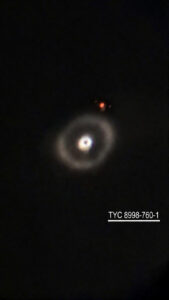
In 2020, astronomers captured the first-ever direct photograph of a young star hosting not one, but two confirmed giant exoplanets orbiting it; TYC 8998-760-1, a Sun-like star 300 light-years away in the constellation Musca; marking a historic leap in our ability to actually see distant planetary systems rather than infer their presence through indirect methods

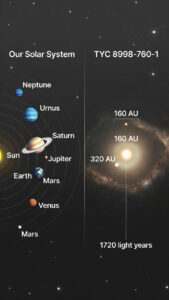
The striking image, published in The Astrophysical Journal Letters by Alexander Bohn and colleagues at Leiden University using the European Southern Observatory’s Very Large Telescope (VLT), shows a bright central disk; the star’s dusty circumstellar envelope; surrounded by two faint point sources: massive gas-giant planets roughly 14 and 6 times Jupiter’s mass. These worlds orbit at vast distances; 160 AU and 320 AU; comparable to the outer reaches of our solar system’s Kuiper Belt. The light in this photo departed the system around the year 1720, when much of the world still relied on horse-drawn carriages, candles, and early telescopes. Direct imaging of multi-planet systems remains extraordinarily rare because planets are billions of times fainter than their host stars and often lost in glare. This breakthrough relied on advanced adaptive optics, coronagraphs to block starlight, and infrared observations to detect the planets’ own heat emission. TYC 8998-760-1, only about 17 million years old, offers a snapshot of a system still forming; providing crucial clues about how giant planets coalesce and migrate in the chaotic early phases of planetary system evolution.
The Challenge of Direct Imaging: Seeing Planets Amid Stellar Glare
Direct imaging of exoplanets demands overcoming immense contrasts: a typical gas giant shines roughly a million to a billion times fainter than its parent star in visible light. Most discoveries rely on indirect techniques; transits dimming starlight, radial velocity wobbles, microlensing, or astrometry; but these reveal orbits and masses without visual confirmation.
The VLT’s SPHERE instrument (Spectro-Polarimetric High-contrast Exoplanet REsearch) excels at high-contrast imaging. It uses extreme adaptive optics to correct atmospheric distortion, a coronagraph to suppress the star’s light, and infrared detectors to capture thermal emission from warm, young planets. For TYC 8998-760-1, the team combined multiple epochs of data to confirm common proper motion; proving the dots move with the star, not as background objects.
The two planets; designated b and c; are exceptionally massive and distant, making them brighter and easier to separate from the star than closer, smaller worlds. Their youth keeps them hot (~1,000–1,500 K), glowing in infrared.
Meet the Star and Its Planetary Companions
TYC 8998-760-1 is a young (17 ± 3 million years old) pre-main-sequence star of spectral type G6 K0, roughly 1.1 solar masses and slightly larger than the Sun. It is surrounded by a massive protoplanetary disk of gas and dust; visible as the glowing ring in the image; still actively forming planets.

The inner planet (b) orbits at ~160 AU with an estimated mass of 14 ± 3 Jupiter masses, while the outer (c) circles at ~320 AU with ~6 ± 2 Jupiter masses. These wide orbits suggest formation via gravitational instability in the disk rather than core accretion (the dominant model for closer-in giants). Their separation; twice Pluto’s distance from the Sun; offers a rare view of an undisturbed outer planetary architecture.
The system’s youth means the planets still radiate significant heat from formation, making them detectable in infrared. Future observations could track their orbits, refine masses, and search for additional companions or disk features.
Why This Image Marks a Milestone in Exoplanet Science
Before this discovery, only a handful of directly imaged exoplanets existed; mostly single massive worlds orbiting very young or very massive stars (e.g., HR 8799’s four-planet system imaged in 2008, but confirmed over years). TYC 8998-760-1 became the first unambiguous multi-planet system captured in one snapshot, proving direct imaging can reveal full architectures.
The image tests formation theories: wide-orbit giants challenge core-accretion models that favor closer-in planets, supporting gravitational instability or outward migration scenarios. It also provides a template for interpreting disks around other young stars; gaps, rings, and asymmetries often signal hidden planets.
Future instruments; JWST’s coronagraphs, ELT’s MICADO and METIS, or Roman Space Telescope; will push deeper, imaging smaller, closer-in worlds and refining atmospheric compositions.


Leave a Reply