


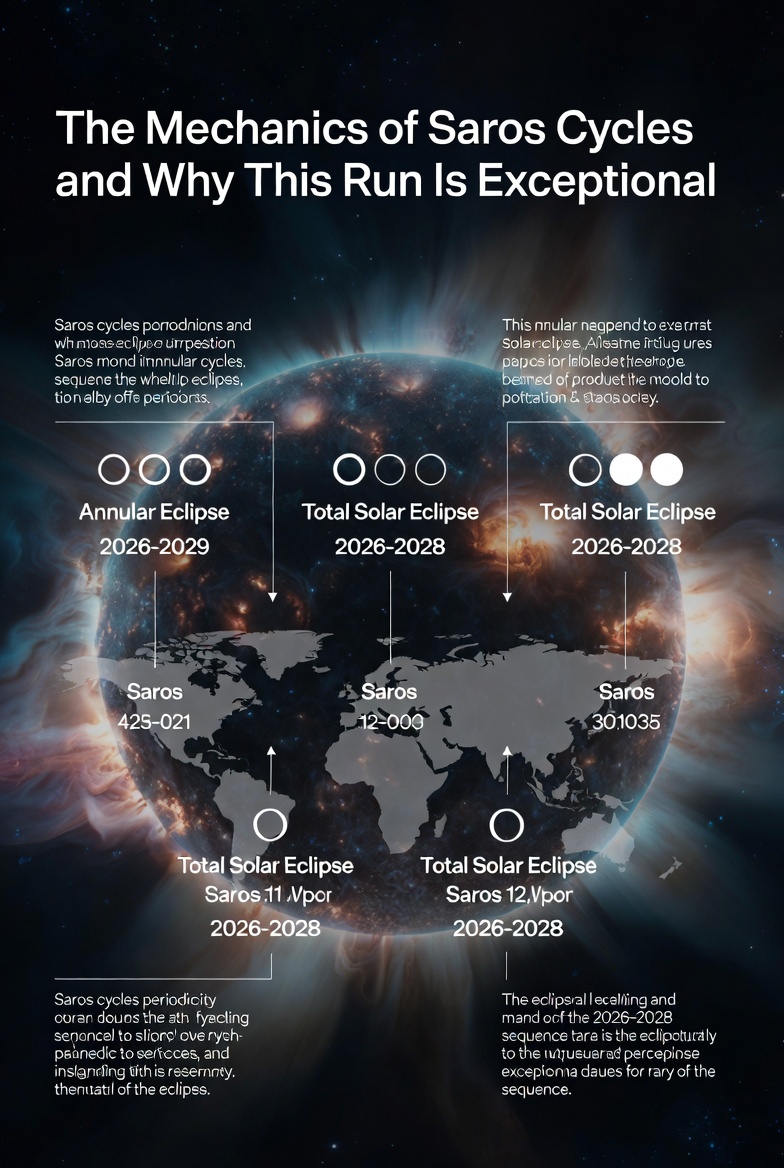
From February 2026 through July 2028, the skies will deliver an extraordinary sequence of six solar eclipses three annular “Ring of Fire” events and three total blackouts thanks to overlapping Saros cycles that align paths over diverse, often populated regions across every inhabited continent.
This three-year run stands out as one of the most accessible and geographically varied eclipse series in recent decades. Unlike the 2008–2010 stretch, where many paths crossed oceans, these eclipses favor landmasses with iconic destinations: icy Antarctica, South American fjords, West African coasts, northern European islands, Spanish cities, North African deserts, Egyptian monuments, and Australian landmarks. Eclipse chasers call it a “once-in-a-generation” window three total solar eclipses on three continents within roughly 23 months, plus three annulars for variety. It begins with the remote annular eclipse over Antarctica on February 17, 2026, and builds momentum through dramatic totals that could draw millions of viewers. Each event showcases the Moon’s precise orbital dance with Earth and Sun, reminding us how rare perfect alignments are. With paths crossing cultural and natural hotspots, this era promises unforgettable spectacles and a surge in global skywatching
The Mechanics of Saros Cycles and Why This Run Is Exceptional
Solar eclipses repeat in families called Saros series each lasting about 18 years and 11 days, with 70 80 eclipses per cycle. Consecutive Saros events shift westward by roughly 120° longitude due to the Moon’s nodal precession.
The 2026–2028 cluster arises from three overlapping Saros series (Saros 121, 122, and 131 for totals; 140, 141, and others for annulars), creating back-to-back major eclipses. This convergence produces six significant events in under 30 months a density not seen since the early 21st century.
Annular eclipses occur when the Moon is near apogee, appearing smaller and leaving a bright ring. Total eclipses need the Moon near perigee for full coverage. The mix here offers contrast: fiery rings for remote or southern viewers, total darkness (with corona visible) for broader populations.
This era’s paths favor land over water, increasing accessibility and cultural impact compared to ocean-heavy runs.
The Annular “Ring of Fire” Eclipses: Antarctica to Spain
February 17, 2026 (Saros 141): Annularity sweeps remote western Antarctica (maximum 2 min 20 sec near 64°S, 87°E). Partial phases reach southern South America and southern Africa. Ideal for research stations; live streams bring the ring to global audiences
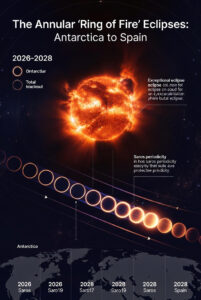
- February 6, 2027 (Saros 141): Path crosses southern Chile and Argentina (Patagonia fjords), then West Africa (Gabon, Congo, DR Congo, Angola). Maximum annularity ~7 min 50 sec—long for annulars offering extended ring views in accessible regions.
- January 26, 2028 (Saros 141): Annularity arcs over the Galápagos Islands (Ecuador) and mainland Spain (Andalusia to Catalonia). Maximum ~7 min 30 sec. The Galápagos and Spanish cities provide prime land-based viewing, blending wildlife and urban settings.
These annulars showcase the Moon’s apogee phase, with bright sunlight rings and subtle chromospheric flashes.
The Total Solar Eclipses: Three Continents in Quick Succession
- August 12, 2026 (Saros 126): Totality crosses western Greenland, Iceland, and northern Spain (up to 2 min 18 sec). Path includes Reykjavik outskirts and Spanish Galicia northern Europe’s turn for totality.
- August 2, 2027 (Saros 136): One of the longest totals of the era (~6 min 23 sec maximum near Luxor, Egypt). Path stretches from Atlantic Morocco, through northern Algeria, Tunisia, Libya, Egypt (Cairo, Giza pyramids), Saudi Arabia, Yemen, and into the Indian Ocean. Dense population centers and ancient sites make this a historic event.
- July 22, 2028 (Saros 136): Totality sweeps across Sydney (Australia), parts of New South Wales, outback, and New Zealand’s South Island (up to 5 min 10 sec). Urban viewing in Sydney and scenic New Zealand fjords offer spectacular corona views.
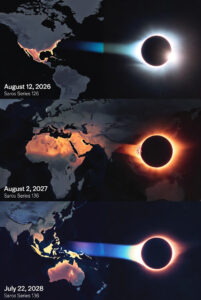 These totals reveal the Sun’s corona, prominences, and diamond-ring effects moments of profound darkness and wonder.
Why This Era Captivates Skywatchers and Chasers
The combination of accessibility, variety, and iconic locations sets this run apart. Millions may witness totality in 2027–2028 alone, from European cities to Egyptian wonders to Sydney harbors. Annulars add fiery drama in biodiverse and scenic spots.
Preparation tips: For totals, travel to the path center for longest duration; use eclipse glasses for partial phases. Apps (e.g., TimeandDate, NASA) track exact timings. Weather is key desert and southern sites often favor clear skies.
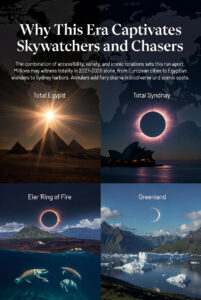 Scientifically, these events enable corona studies, atmospheric refraction, and animal behavior research during sudden darkness.
Embracing the Cosmic Rhythm
This 2026–2028 eclipse era reminds us of celestial predictability and rarity Saros cycles weave patterns over centuries, yet perfect land alignments remain fleeting. Starting with Antarctica’s remote ring and building to Sydney’s urban totality, the sequence invites global participation
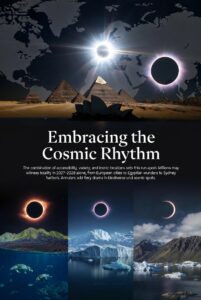 Whether chasing all six or catching one nearby, the experience fosters awe: brief moments when Moon, Sun, and Earth align perfectly. Plan ahead, protect your eyes, share the view, and step into history. The skies are about to deliver a rare, unforgettable chapter clear horizons and cosmic wonder await across the next few years.


Leave a Reply