


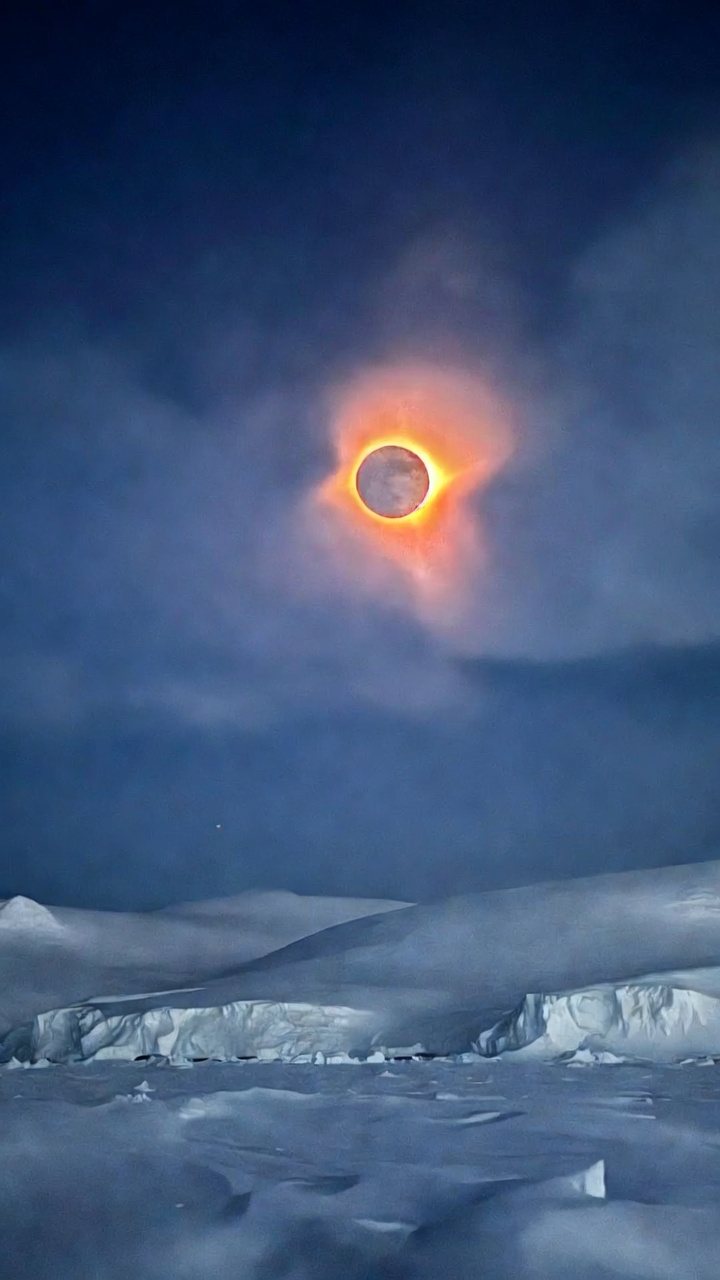
On February 17, 2026, one of Earth’s most isolated continents becomes the stage for a dramatic annular solar eclipse, where the Moon slightly too distant to fully obscure the Sun creates a blazing “Ring of Fire” over western Antarctica, while southern tips of South America and Africa catch deep partial phases.
catch deep partial phases.
This event unfolds in extreme remoteness, favoring penguins and research stations over crowds, yet its beauty captivates globally through live streams. The annular solar eclipse occurs because the Moon is near apogee (farthest from Earth), appearing smaller and leaving a brilliant ring of sunlight around its dark silhouette. Maximum annularity lasts 2 minutes and 20 seconds near 64°42′S, 86°48′E, with the path stretching 2,661 miles (4,282 km) long and up to 383 miles (616 km) wide. Partial views extend far wider, dimming the Sun noticeably in southern regions. As the first solar eclipse of 2026, it kicks off a remarkable series including total eclipses in August 2026 and beyond—highlighting the Moon’s evolving orbital dance. With safety paramount, certified solar filters are essential for any direct viewing. For most, online broadcasts from observatories or expeditions offer the best access to this cosmic wonder.
What Defines an Annular Solar Eclipse? The Basics
Solar eclipses happen at new moon when the Moon aligns between Earth and the Sun, casting a shadow. Types vary by apparent sizes: total (Moon fully blocks Sun), partial (partial overlap), and annular (Moon too small for total coverage, forming a ring).
The Moon’s orbit is elliptical, so distance varies: at perigee (closest), it appears larger; at apogee, smaller. On February 17, 2026 6.8 days post-apogee (February 10) and 7.5 days pre-perigee (February 24)—the Moon’s disk covers ~96% of the Sun (magnitude 0.963), creating the annulus.
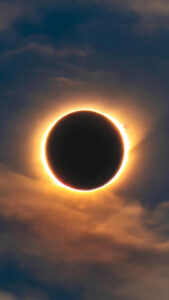
The shadow cone: umbra (dark, for totality) becomes an antumbra (beyond tip, for annularity) when the Moon is distant. Observers in the antumbra see the ring; surrounding penumbra yields partials.
This alignment tests orbital precision—predictable yet rare in specific locations.
The Path and Phases: Antarctica’s Spotlight Moment
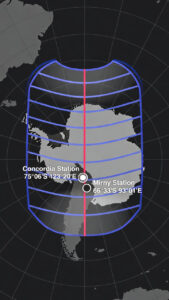
The path of annularity crosses remote western Antarctica, rising over the interior and setting off the Davis Sea coast in the Southern Ocean. Greatest eclipse hits at 12:13 UTC, with annularity up to 2 minutes 20 seconds.
Key sites: Concordia Station (French-Italian) sees ~2 minutes 5 seconds; Mirny Station (Russian) ~1 minute 52 seconds. McMurdo Station experiences a deep partial (Sun ~86% covered). The path favors high-latitude, icy terrain accessible mainly to research teams or extreme adventurers via cruises.
Partial phases span southern South America (tips of Chile and Argentina), southern Africa (South Africa, Mozambique, Madagascar), and vast oceans (Pacific, Atlantic, Indian). In populated southern edges, the Sun appears with a glowing “bite” taken out—dramatic but requiring filters.
The eclipse starts ~09:56 UTC (partial onset), peaks at midday UTC, ends later. Antarctic summer timing aids visibility, though weather (clear skies crucial) remains unpredictable.
Why This Eclipse Matters and the Coming Series
Annular eclipses offer scientific perks: study the Sun’s chromosphere and prominences along the ring, atmospheric effects on wildlife, or subtle temperature drops. In Antarctica, it highlights isolation few witnesses, yet profound impact.
This event launches a “golden age” of eclipses: 2026–2028 features three annular (February 2026, February 2027, January 2028) and three total (August 2026, August 2027, July 2028) a pattern unseen since 2008–2010. Upcoming totals include August 12, 2026 (over Europe, Iceland, Spain), promising broader access.
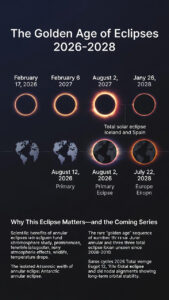
Such sequences arise from Saros cycles and nodal alignments, reminding us of long-term orbital stability.
Safety First and Viewing Options
Never view the Sun directly without proper protection certified eclipse glasses (ISO 12312-2) or solar filters block harmful UV/IR rays. Instant blindness can result from unprotected glances.
For direct viewing: Use glasses during partial phases; indirect methods like pinhole projectors work safely.
Most will watch via live streams NASA, TimeandDate.com, or Antarctic station feeds often provide high-quality coverage. Apps simulate paths for your location.
This remote spectacle underscores astronomy’s accessibility: even unwitnessed in person, shared digitally, it unites global curiosity.
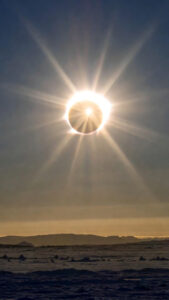
Would you tune in for live views if possible? The “Ring of Fire” over Antarctica promises surreal beauty golden light piercing polar silence.
As February 17 arrives, prepare: check streams, grab filters if viewing partials, and appreciate the cosmos’s precision. From icy wastes to screens worldwide, this eclipse bridges extremes, sparking wonder in our shared sky. Clear horizons, safe viewing, and cosmic awe await.


Leave a Reply