


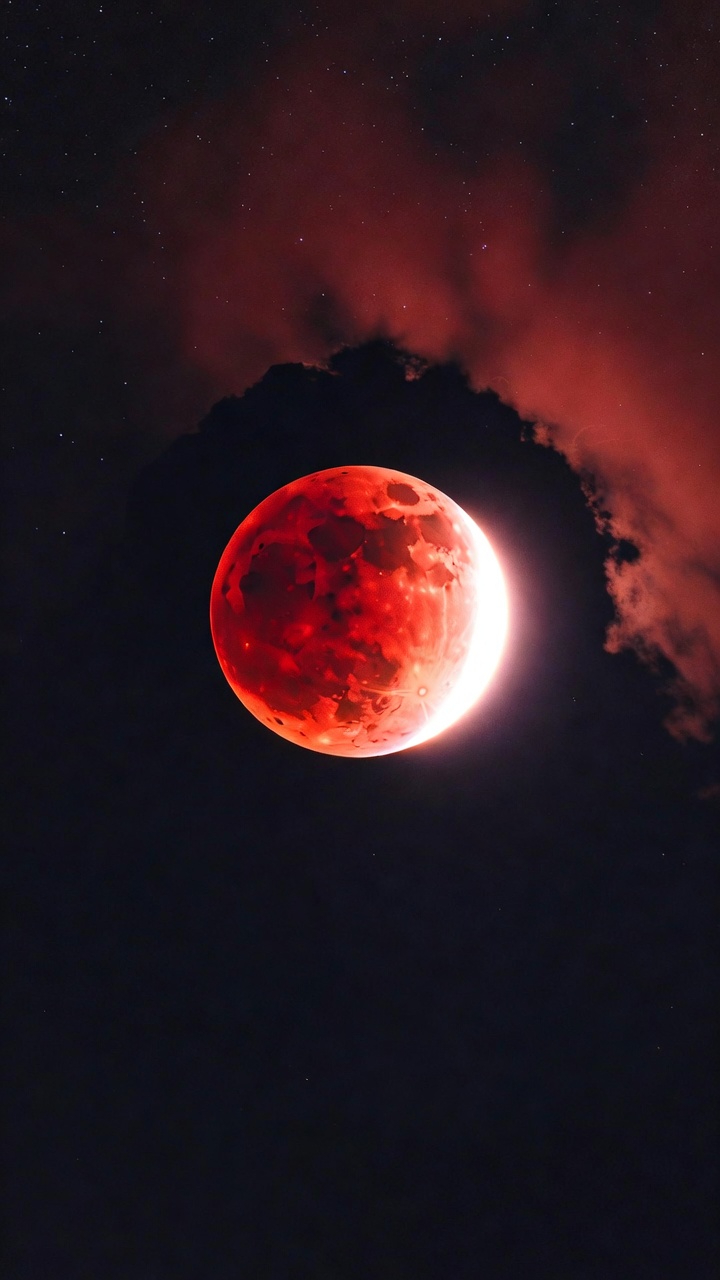
On the night of March 2 3, 2026, the full Moon will slip into Earth’s shadow for a total lunar eclipse, transforming into a deep, coppery-red “Blood Moon” that captivates skywatchers across wide swaths of the globe no special equipment required, just clear skies and a sense of wonder.
This celestial drama unfolds when Earth aligns perfectly between the Sun and the full Moon, casting its dark umbra across the lunar disk. Rather than vanishing into blackness, the Moon takes on an eerie reddish hue as sunlight filters through Earth’s atmosphere, scattering blue light and leaving reds and oranges to bathe the surface. The effect resembles the fiery colors of a sunset or sunrise viewed from space only now the Moon becomes the canvas. Totality lasts nearly an hour, offering plenty of time to marvel at the transformed orb hanging in the night sky. Visible to the naked eye from anywhere the Moon is above the horizon during the event, this eclipse stands out for its accessibility, duration, and vivid color. With the current date in mid-February 2026, preparations are underway: check weather forecasts, find an open viewing spot, and share the excitement. It’s a rare, free spectacle that turns an ordinary night into a shared cosmic experience.
The Science Behind a Total Lunar Eclipse
A lunar eclipse occurs exclusively at full moon, when the Moon, Earth, and Sun line up nearly perfectly. Earth’s shadow has two parts: the faint outer penumbra (causing gradual dimming) and the dark central umbra (producing totality when the Moon enters fully).
During totality, direct sunlight is blocked, but Earth’s atmosphere acts as a filter. Shorter blue wavelengths scatter away (Rayleigh scattering), while longer red wavelengths bend around the planet’s curve and reach the Moon. This refracted light—essentially every sunrise and sunset on Earth combined—illuminates the lunar surface in shades from pale pink to deep brick red. The exact hue depends on atmospheric conditions: dust, volcanic aerosols, or pollution can darken or brighten the color.
The March 3, 2026, eclipse is relatively shallow (umbral magnitude ~1.15), so the Moon stays fairly bright and coppery rather than very dark. Totality spans 58 minutes, from roughly 11:04 to 12:02 UTC, with maximum eclipse at 11:34 UTC. The entire sequence penumbral start to full exit lasts over 5 hours and 39 minutes.
Compare it to standing inside a giant red-tinted tunnel: Earth’s shadow engulfs the Moon, but atmospheric “windows” let crimson light through.
Timeline and Visibility of the March 3 Eclipse
The eclipse timeline (in UTC; convert to local time):
- Penumbral eclipse begins: ~08:44 UTC (gradual dimming starts)
- Partial eclipse begins: ~09:50 UTC (dark bite appears on Moon’s edge)
- Totality begins: ~11:04 UTC
- Greatest eclipse: ~11:34 UTC (deepest red phase)
- Totality ends: ~12:02 UTC
- Partial ends: ~13:16 UTC
- Penumbral ends: ~14:22 UTC
Visibility covers the night side of Earth during key phases. Prime locations include Australia, the Pacific region, East Asia, and much of North and South America. In western North America, totality occurs in the early morning hours (e.g., around 4:04–5:02 a.m. local in many areas), while eastern regions may see only partial phases before moonset. Parts of Europe and Africa catch the Moon rising or setting during partial or total stages, offering dramatic horizon views.
No portion requires a telescope binoculars or a small scope enhance crater details under the red glow but naked-eye viewing delivers the full magical effect. The Moon appears larger and more striking near the horizon due to the Moon illusion.
Cosmic Context and Lasting Wonder
Lunar eclipses offer more than visuals they highlight Earth’s atmosphere in a unique way and connect us to ancient skywatchers who tracked similar events. Scientifically, color analysis reveals upper-atmospheric details, and precise timings refine orbital models.
This March 3 event fits into a busy 2026 eclipse year, following the February annular solar eclipse and preceding others later. It reminds us how three celestial bodies can align to create global drama.


Leave a Reply