


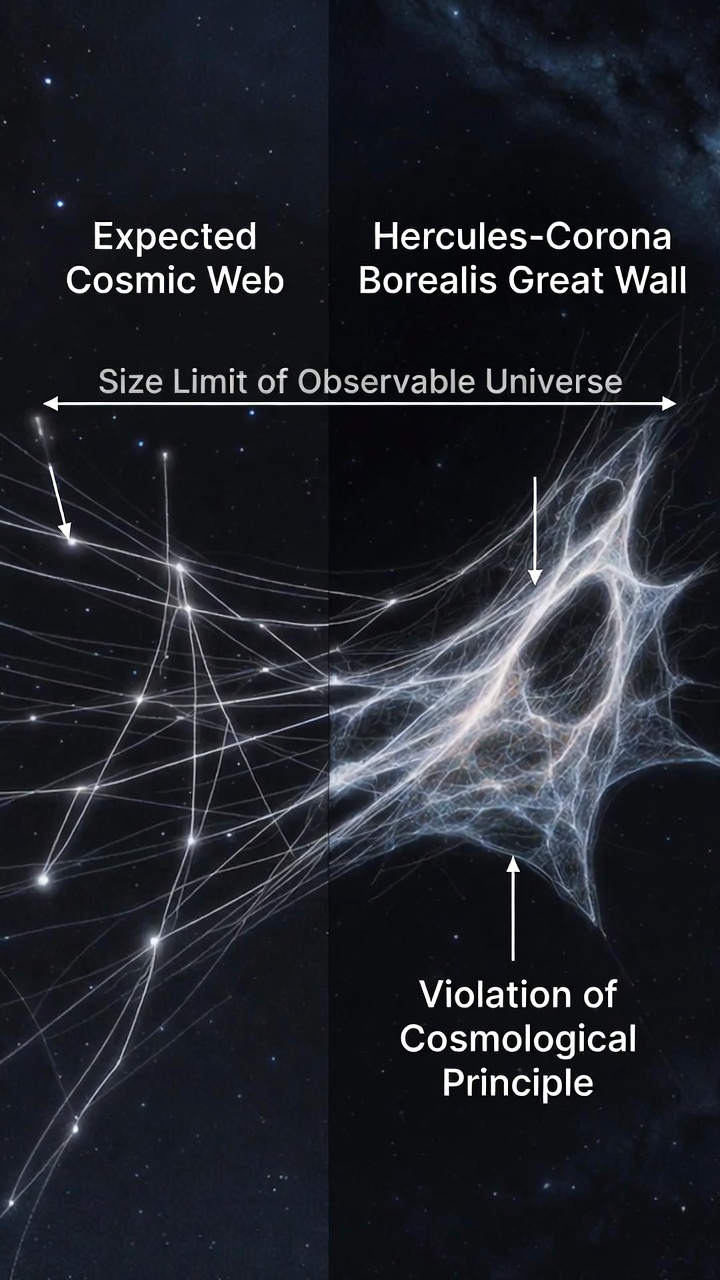
Stretching across an astonishing expanse that may reach 15 billion light-years, the Hercules–Corona Borealis Great Wall stands as the largest known structure in the observable universe a vast cosmic filament of galaxies, clusters, and gamma-ray bursts that challenges our deepest assumptions about the cosmos.
Discovered in 2013 through analysis of gamma-ray bursts (GRBs) from NASA’s Swift satellite, this colossal “wall” isn’t a solid barrier but a sprawling web of matter bound by gravity over cosmic time. Recent 2025 studies, expanding on datasets from hundreds of GRBs, suggest it’s even larger than the original 10 billion light-year estimate potentially spanning from redshift 0.33 to 2.43, translating to roughly 15 billion light-years in extent. Located in the direction of the constellations Hercules and Corona Borealis, it dwarfs everything else we know, encompassing densities far beyond average cosmic scales. To grasp its immensity: if Earth were a grain of sand, this structure would dwarf entire planetary systems in comparison. Its discovery via GRBs—intense explosions marking the deaths of massive stars reveals concentrations of galaxies where these events cluster unusually. Amid ongoing debates about its precise nature and existence, the Hercules Corona Borealis Great Wall pushes cosmology to its limits, hinting at rare deviations from uniformity in the vast tapestry of space.
As astronomers refine data from surveys like BOSS (Baryon Oscillation Spectroscopic Survey) and GRB catalogs, this megastructure captivates as a reminder of the universe’s mind-blowing scale and hidden complexities.
What Is the Hercules Corona Borealis Great Wall? Fundamentals of Cosmic Structures
Large-scale cosmic structures form filaments, walls, voids, and superclusters networks shaped by gravity pulling matter together since the Big Bang. Galaxy filaments are thread-like chains of galaxies and clusters, often stretching hundreds of millions to billions of light-years.
Discovered in 2013 by István Horváth, Jon Hakkila, and Zsolt Bagoly using 283 GRBs, initial clustering appeared at redshifts 1.6–2.1 (roughly 9 10 billion years ago). Later analyses, including 2020 confirmations and 2025 expansions to 542 GRBs, bolster its reality while extending its span. It’s not a monolithic wall but a complex of smaller clusters linked by filaments, with thickness around 1 billion light-years and width up to 7 10 billion in some dimensions.
Compare to familiar scales: the Milky Way spans ~100,000 light-years; our Local Group ~10 million; the Laniakea Supercluster (containing us) ~500 million. This wall dwarfs them all, spanning ~10–15% of the observable universe’s diameter (~93 billion light-years)
How It Was Discovered and Measured: Gamma-Ray Bursts as Cosmic Tracers
Astronomers map large structures via galaxy surveys (e.g., Sloan Digital Sky Survey, BOSS) or proxies like quasars and GRBs. GRBs excel for distant probes: bright enough to detect across billions of light-years, their redshifts yield precise distances.
billions of light-years, their redshifts yield precise distances.
The 2013 team spotted 19–22 GRBs clustered unusually in the northern galactic hemisphere, far exceeding random expectations. Statistical tests ruled out chance, with p-values indicating significance.
Follow-up work refined this: a 2020 paper supported clustering in reliable datasets, calling for future missions like THESEUS for confirmation. The 2025 study (arXiv 2504.05354) used expanded GRB samples and redshift precision, finding overdensity from z=0.33 (~4 billion light-years) to z=2.43 (~11–12 billion), yielding ~15 billion light-years total 50% larger than prior estimates.
Debates persist: some analyses suggest statistical artifacts or biases, but recent evidence strengthens the case. It’s thicker and extends closer/farther than thought, challenging models.
Why It Challenges Cosmology: The Cosmological Principle in Question
The cosmological principle assumes the universe is homogeneous (uniform density) and isotropic (same in all directions) on large scales. Standard models predict structures limited to ~1.2 billion light-years max, as inflation smoothed early fluctuations.
This wall—10–15 times larger violates that limit, implying extreme deviations or rare fluctuations. If real, it questions how matter clumped so massively post-Big Bang, perhaps requiring tweaks to dark matter, inflation, or gravity models.
It joins anomalies like the Giant Arc or Huge-LQG, suggesting the universe has more hierarchy than expected. Yet homogeneity holds on average; such giants may be statistical rarities in vast space.
Implications ripple: better understanding large-scale structure refines dark energy measurements, galaxy formation, and cosmic evolution.
The Bigger Picture: A Mind-Blowing Masterpiece and Future Insights
This “Great Wall” showcases gravity’s patient sculpting over billions of years, weaving galaxies into immense patterns. Its GRB tracers reveal star-forming peaks in dense regions, linking to early universe violence.
Future missions—THESEUS satellite, Euclid telescope, or advanced GRB detectors—will map it definitively, testing existence and size. If confirmed, it reshapes cosmology; if artifact, it sharpens statistical tools.


Leave a Reply