


The image depicts a breathtaking night sky where all eight planets of our solar system (Mercury, Venus, Earth, Mars, Jupiter, Saturn, Uranus, and Neptune) are shown aligned in a spectacular “planetary parade” above a misty mountain range, with the Milky Way glowing in the background. The caption claims that on February 28, every planet will align in the sky for a rare event that won’t happen again until 2040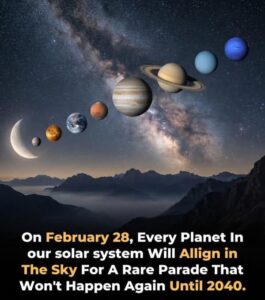
A planetary alignment occurs when multiple planets gather on the same side of the Sun, appearing close together in the sky.
Perfect alignment of all eight planets is extremely rare due to their different orbital planes and periods.
The actual visibility and timing of planetary alignments depend on celestial mechanics and observational conditions (e.g., daylight, horizon position).
Astronomical events like this are often predicted by ephemerides (tables of planetary positions).
The next notable multi‑planet alignment will involve fewer planets and can be observed with proper astronomical tools or sky‑watching apps
The Sun‑Earth Light Travel Time
The image shows the Sun and Earth in space with arrows indicating the path of sunlight. The caption states that it takes 8 minutes and 19 seconds for light to travel from the Sun to the Earth
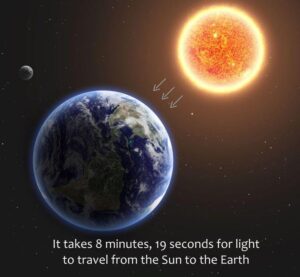
The average distance between the Sun and Earth is about 149.6 million kilometers (1 Astronomical Unit)
Light travels at 299,792 kilometers per second in a vacuum.
The time for light to cover the Sun‑Earth distance is calculated as distance ÷ speed, yielding approximately 499 seconds (8 min 19 s).
This delay means we see the Sun as it was 8 minutes and 19 seconds ago, not in real time
The Sun’s Energy Journey: From Core to Earth
The infographic illustrates the remarkable time difference between the energy generated in the Sun’s core and its arrival on Earth. It shows the Sun on the left and Earth on the right, with a dotted line indicating the two time scales involved in this energy travel
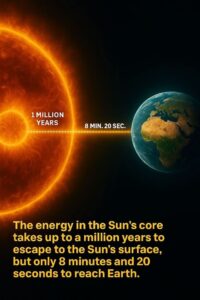
Energy produced in the Sun’s core takes about 1 million years to work its way out to the Sun’s surface due to repeated absorption and re‑emission in the dense solar interior
Once the energy reaches the Sun’s surface, it travels through space at the speed of light and arrives on Earth in 8 minutes and 20 seconds.
This contrast highlights the slow diffusion process inside the Sun versus the swift radiation travel through the vacuum of space
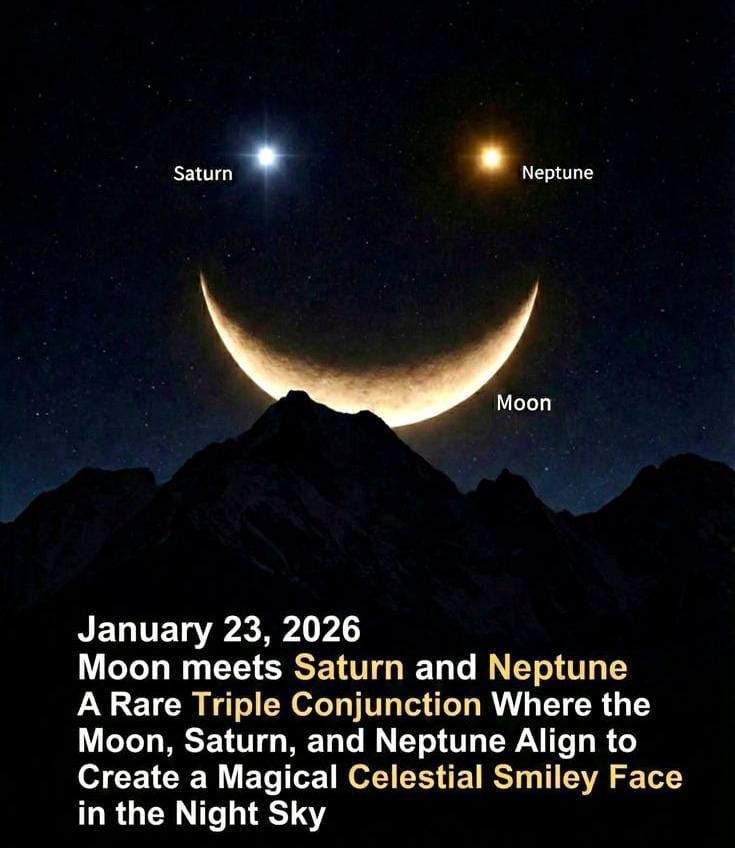
Celestial Smiley: Moon, Saturn & Neptune Triple Conjunction
The image captures a rare astronomical event on January 23, 2026, where the crescent Moon aligns with the planets Saturn and Neptune, forming a whimsical “smiley face” in the night sky over a mountain silhouette. The bright white dot of Saturn sits near the “eye” position, while the golden glow of Neptune forms the other “eye,” and the curved Moon makes the smiling “mouth
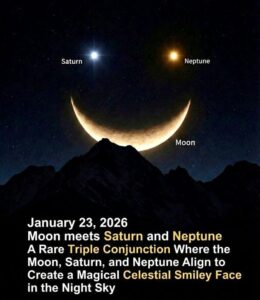
Event: Triple conjunction of Moon, Saturn, and Neptune.
Date: January 23, 2026.
Appearance: The three celestial bodies line up to resemble a smiley face against the dark sky.
Visibility: Best viewed in clear, dark skies; the Moon’s crescent phase makes the alignment visually striking.
Astronomical note: Conjunctions are apparent close approaches in the sky; Saturn (ringed planet) appears brighter, while Neptune (ice giant) is fainter and golden‑ish due to atmospheric scattering


Leave a Reply