


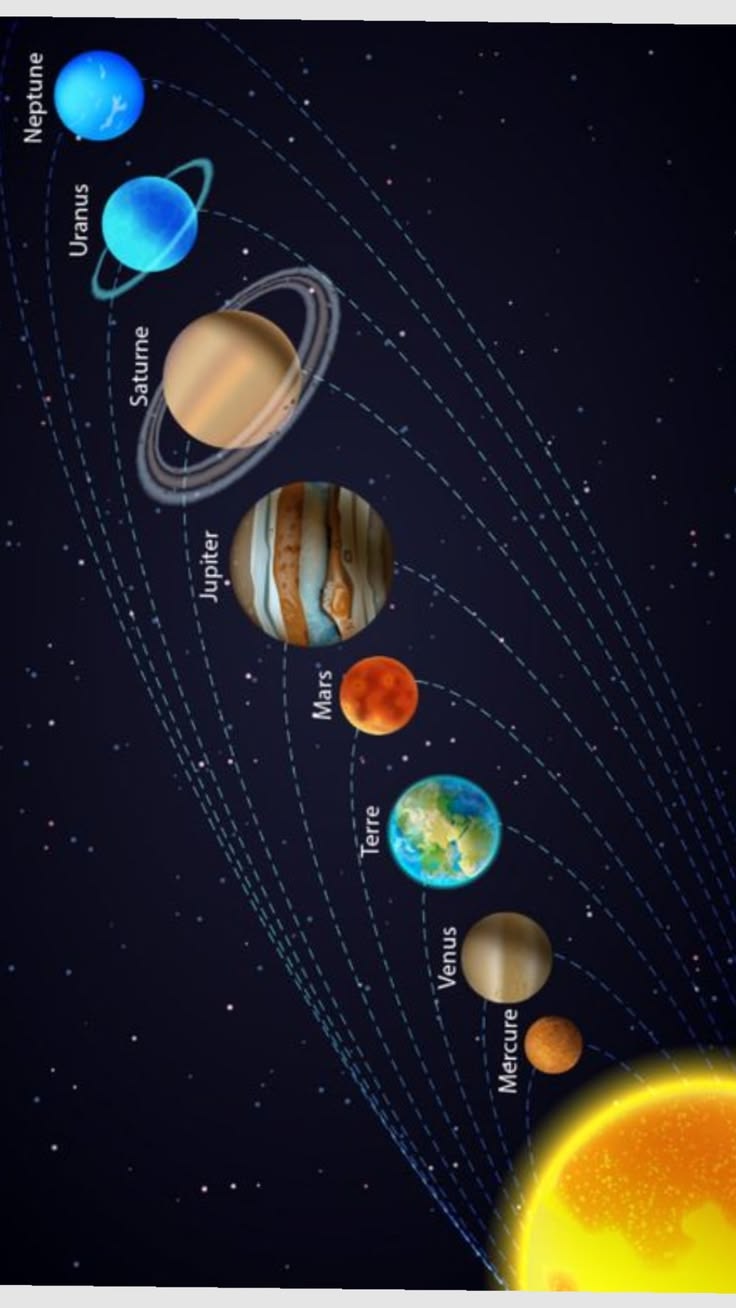
The image shows a stacked visual comparison of the eight planets in our solar system (plus the Moon) arranged by their relative diameters. Each planet is represented with its actual image and labeled with its mean diameter in kilometers. The arrangement starts with the smallest (Mercury) at the top and builds up to the largest (Jupiter) at the bottom, with Earth placed beside Jupiter for scale
 Moon: 3,474 km (for reference)
Mercury: 4,879 km – smallest planet.
Mars: 6,790 km – the Red Planet.
Venus: 12,104 km – similar in size to Earth.
Neptune: 49,244km – km – icy giant.
Uranus: 51,118 tilted axis gives extreme seasons.
Saturn: 116,464 km – gas giant with prominent rings.
Jupiter: 142,984 km – largest planet, shown with Earth for size comparison
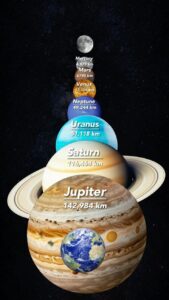
The Solar System Planetary Order (French Labelled)
The image shows an illustrated diagram of the Solar System with the Sun at the bottom right and the eight planets arranged in their orbital paths (dashed lines) moving outward. The planets are labelled in French: Mercure (Mercury), Vénus (Venus), Terre (Earth), Mars, Jupiter, Saturne, Uranus, Neptune. The depiction highlights their relative positions and distinctive features (e.g., Saturn’s rings).
1. Planetary sequence (from the Sun):
Mercure (Mercury)
Vénus (Venus)
Terre (Earth)
Mars
Jupiter
Saturne (Saturn)
Uranus
Neptune
Solar System Planets & Their Key Features
The infographic showcases the eight planets of our solar system, arranged in order from the Sun outward, highlighting their size, color, atmosphere, and unique traits
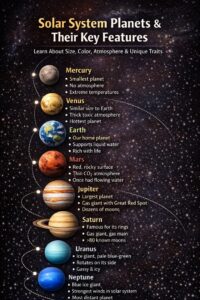
Planet Summaries1. Mercury – smallest planet; has no atmosphere; experiences extreme temperature swings.
2. Venus similar in size to Earth; thick, toxic atmosphere; the hottest planet.
3. Earth our home planet; supports liquid water; rich with life.
4. Mars red, rocky surface; thin CO₂ atmosphere; once had flowing water.
5. Jupiter largest planet; gas giant with the Great Red Spot; dozens of moons.
6. Saturn famous for its rings; gas giant; >80 known moons.
7. Uranus ice giant with pale blue‑green color; rotates on its side; gassy & icy composition.
8. Neptune blue ice giant; strongest winds in the solar system; the most distant planet.
Quick Facts- The planets are shown with their orbital paths around the Sun.
The visual emphasizes comparative size and distinctive colors of each planet.
Key atmospheric and geological characteristics are listed for easy reference.
You want me to focus on any specific planet or aspect of the solar system for more detail 🌌🚀
The Solar System Planetary Arrangement (with Pluto)
The image shows an illustrated view of our Solar System with the Sun at the bottom and the eight planets (plus dwarf planet Pluto) aligned vertically along elliptical orbital paths. The planets are depicted in relative size and color, orbiting the Sun in the order: Mercury, Venus, Earth, Mars, Jupiter, Saturn, Uranus, Neptune, and finally Pluto (shown as a dwarf planet beyond Neptune)
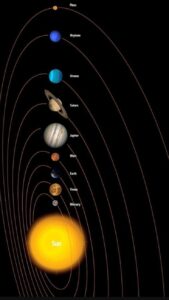 Planets (in order from the Sun)
Mercury, Venus, Earth, Mars, Jupiter, Saturn, Uranus, Neptune.
Dwarf planet shown: Pluto (located beyond Neptune).
Orbital representation: Elliptical paths indicate each planet’s orbit around the Sun.
Visual style: The Sun is a glowing yellow sphere; planets are color‑coded with realistic textures; orbits are thin orange ellipses on a black space background
Solar System Planetary Orbits & Revolution Periods
The image illustrates the Sun at the center with the eight planets (and dwarf planet Pluto) arranged along their elliptical orbital paths. Each planet is labeled with the time it takes to complete one full revolution around the Sun, shown in Earth days or years
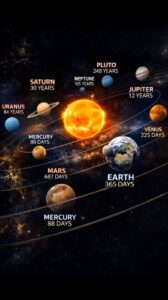
Mercury: 88 days
Venus: 225 days
Earth: 365 days
Mars: 687 days
Jupiter: 12 years
Saturn: 30 years
Uranus: 84 years
Neptune: 165 years
Pluto (dwarf planet): 248 years
The diagram visually compares the relative orbital periods, highlighting how inner planets have shorter years while outer planets take many Earth years to orbit the Sun


Leave a Reply