


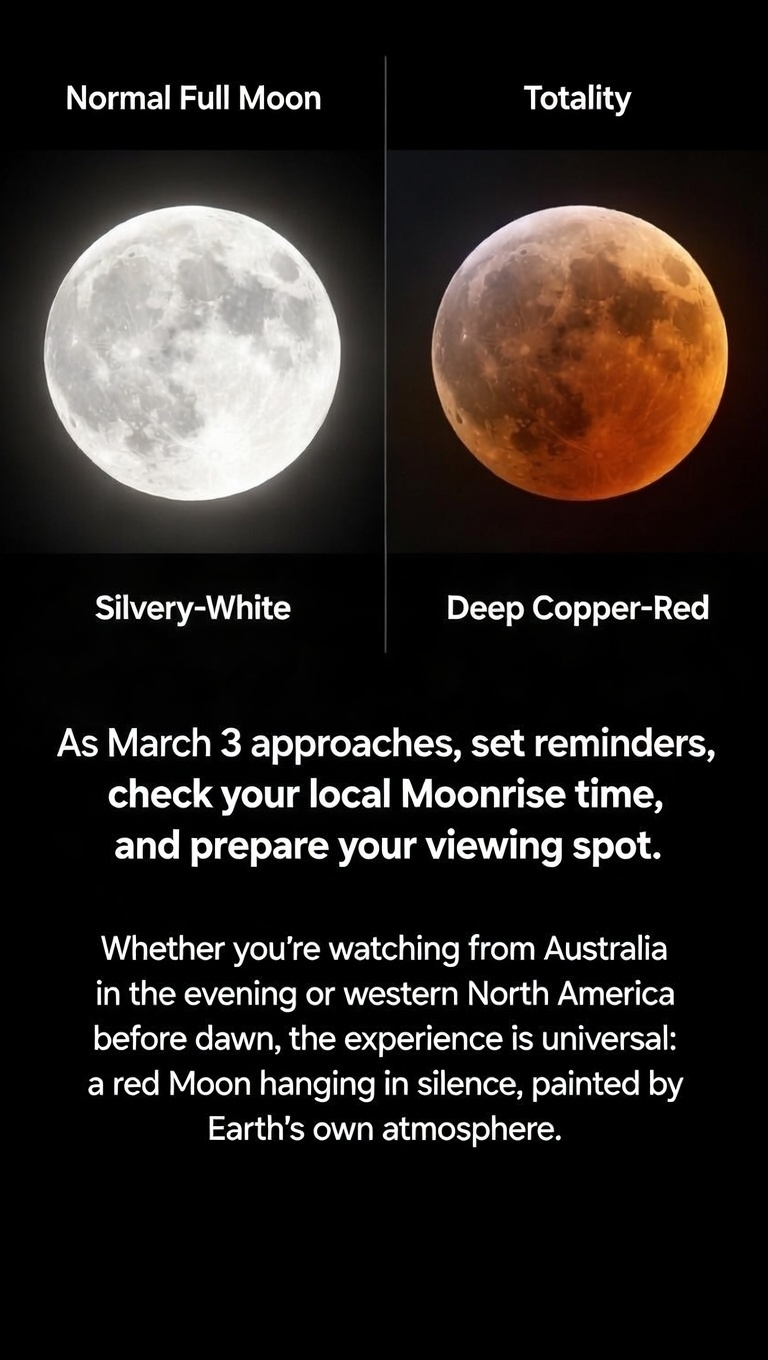
Mark your calendars; on the night of March 2 into March 3, 2026, the full Worm Moon will undergo a total lunar eclipse, transforming into a glowing, deep blood-red spectacle during 58 minutes of totality, delivering one of the most visually striking and longest-lasting lunar eclipses in recent years
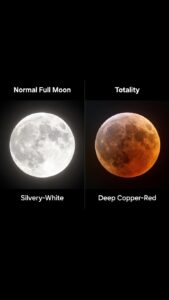
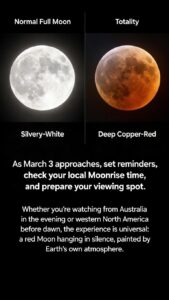
This breathtaking event occurs when the Sun, Earth, and full Moon align precisely, with Earth passing directly between them and casting its dark umbral shadow across the lunar surface. Rather than vanishing into blackness, the Moon takes on an eerie coppery-red or brick-red hue; earning the name “Blood Moon”; because sunlight filters through Earth’s atmosphere. Shorter blue wavelengths scatter away, while longer red wavelengths bend around the planet’s curve and reach the Moon, bathing it in the collective glow of every sunrise and sunset happening simultaneously on Earth. The color can vary from bright orange-copper (clean air) to deep rusty red (dusty or volcanic conditions). Totality lasts a generous 58 minutes, giving ample time to watch the slow, mesmerizing shift from partial shading to full immersion and back. The entire eclipse spans over five hours, making it family-friendly and accessible; no telescope or special filters required, just clear skies and an open view
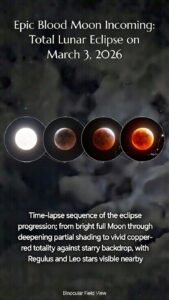
Detailed Timeline (UTC)
- Penumbral eclipse begins: ~08:44 UTC (subtle dimming starts)
- Partial eclipse begins: ~09:50 UTC (dark bite appears on Moon’s edge)
- Totality begins: ~11:04 UTC
- Maximum eclipse (deepest red phase): ~11:33–11:34 UTC
- Totality ends: ~12:03 UTC (58 minutes’ total)
- Partial eclipse ends: ~13:17 UTC
- Penumbral eclipse ends: ~14:23 UTC
Convert these to local time using apps like Stellarium, SkySafari, or timeanddate.com; enter your city for exact Moonrise, Moonset, and visibility
Where to Watch the Blood Moon
The eclipse is visible wherever the Moon is above the horizon during totality or partial phases. Prime regions include:
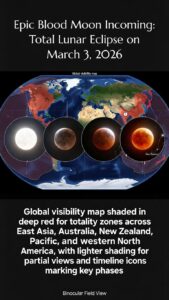
Europe, Africa, and much of western/central Asia will see only faint penumbral dimming or miss the event entirely, as the Moon is below the horizon during totality. This geographic split makes the eclipse feel even more special for those in the prime viewing zones.
The Moon will be positioned near Regulus in Leo, adding a bright golden star to the scene; the red Moon contrasted against sparkling constellations creates a particularly striking visual
Viewing Tips for the Best Experience
No special equipment is needed, but these steps enhance the night
- Find a dark location with an unobstructed view (especially east or southeast depending on region).
- Arrive early to watch the partial phases; the slow creep of Earth’s shadow builds anticipation beautifully.
- Use binoculars or a small telescope to see crater details under the red glow and subtle brightness variations across the disk.
- Dress warmly; nights can be chilly during long watches; bring a blanket, hot cocoa, and perhaps friends or family.
- Check weather forecasts; clear skies are essential.
- Use apps for exact local timings, Moon altitude, and visibility.
If clouds intervene, many observatories, astronomy clubs, and online streams will share live views
Why This Eclipse Feels So Special
Total lunar eclipses occur roughly twice per year somewhere on Earth, but each has its own character. The 58-minute totality here is longer than average, giving plenty of time to observe gradual color changes, enjoy the peaceful red glow, and reflect on the cosmic alignment. The proximity to Regulus adds extra sparkle, turning the night into a quiet celestial portrait
This is the last total lunar eclipse with broad visibility until late 2028, following a packed 2026 eclipse year that included the February annular solar eclipse. These events remind us how interconnected we are with the universe; three celestial bodies aligning perfectly to create a global spectacle.
Culturally, “blood moons” have inspired awe, myths, and storytelling for millennia. Today, they remain pure astronomical beauty; opportunities to pause, look up, and feel small yet connected
Grab Friends and Watch the Cosmos Perform
As March 3 approaches, set reminders, check your local Moonrise time, and prepare your viewing spot. Whether you’re watching from Australia in the evening or western North America before dawn, the experience is universal: a red Moon hanging in silence, painted by Earth’s own atmosphere


Leave a Reply