


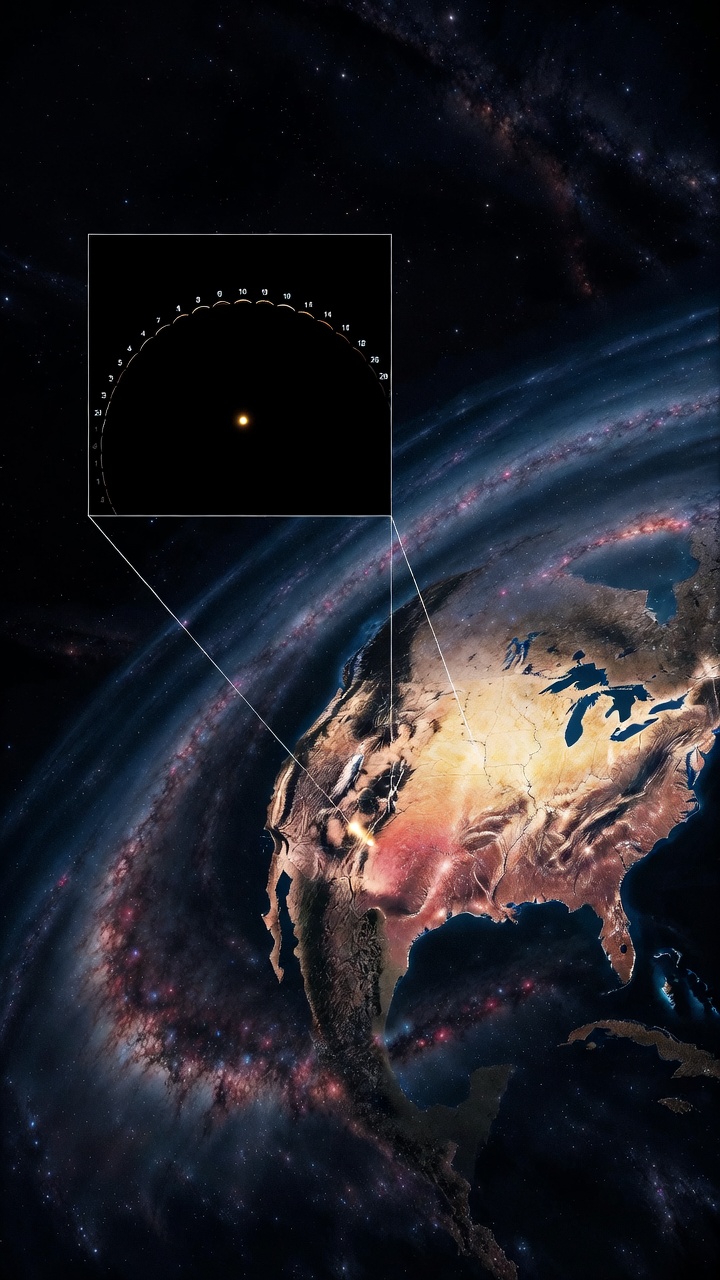
Imagine celebrating your birthday while the Sun itself is quietly marking its 20th “Galactic Year”; a single complete orbit around the Milky Way that takes roughly 225 million Earth years. At 4.6 billion years old, our star has completed exactly 20 of these immense loops and still has fuel for about 22 more before it swells into a red giant. Suddenly, a human lifetime feels like the blink of a cosmic eye.
Let’s break down the math that puts everything into humbling perspective. Earth completes one orbit around the Sun in 365.25 days (accounting for leap years), defining our familiar calendar year. The Sun, however, orbits the galactic center at an average speed of about 828,000 km/h (514,000 mph), traveling roughly 250–260 parsecs (about 800–850 light-years) per million years. This full circuit; the Galactic Year or cosmic year; takes approximately 225–250 million Earth years, with most modern estimates settling around 225–230 million years.
The Sun formed about 4.6 billion years ago from a collapsing molecular cloud. Dividing that age by the length of a Galactic Year:
4,600,000,000 ÷ 225,000,000 ≈ 20.44 Galactic Years

In other words, the Sun is a little over 20 Galactic Years old and roughly halfway through its main-sequence lifetime. It has another 5 billion years or so of core hydrogen fusion left; enough time for approximately 22 more full orbits around the galaxy before it exhausts its fuel, expands into a red giant, and eventually sheds its outer layers to leave behind a white dwarf.
Next time you blow out birthday candles, picture the Sun slowly ticking toward its 21st Galactic birthday; a milestone it won’t reach for another 225 million years. Human civilization, by comparison, has existed for only about 0.00004 Galactic Years. The entire history of Homo sapiens spans less than one ten-thousandth of a single orbit.
Why the Galactic Year Matters: A Broader Cosmic Context
The concept of the Galactic Year helps reframe deep time. During one full orbit:
- The Sun and its planets have traveled roughly 150,000–160,000 light-years along a slightly elliptical path, bobbing up and down through the galactic plane every ~60–70 million years.
- Earth has circled the Sun 225–250 million times, experiencing countless ice ages, mass extinctions, and evolutionary leaps.
- The last time the Sun was in its current galactic longitude (about one Galactic Year ago), Earth hosted the Permian period; just before the largest mass extinction in history wiped out ~96% of marine species
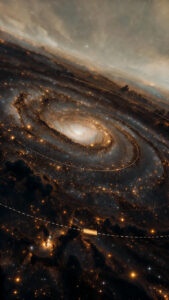
The Sun’s orbit isn’t perfectly circular; it oscillates vertically through the galactic disk and encounters varying densities of stars, gas, and dark matter. These passages may subtly influence comet showers or climate over tens of millions of years, though evidence remains debated.
Mind-Blowing Space Facts to Keep You Up at Night
The Galactic Year is just one gateway to cosmic vertigo. Here are a few more that stretch the imagination:
- If the Sun were the size of a white blood cell (~10 micrometers), the Milky Way would span the continental United States.
- The light from the galactic center takes ~27,000 years to reach us; so we see it as it was when humans were still painting caves in Europe.
- In the time it takes light to travel from one side of our galaxy to the other (~100,000–180,000 years), humanity went from stone tools to smartphones.
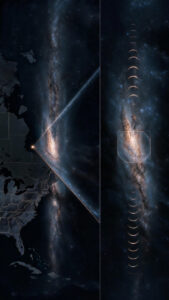
- The observable universe contains roughly 2 trillion galaxies; each potentially hosting billions of stars. If every star were a grain of sand, the beaches of Earth couldn’t hold them.
Which of these; or another space fact entirely; keeps you staring at the ceiling at 3 a.m.? Drop your favorite mind-bender in the comments below!
Bringing It Back to Earth
Cosmic scales can feel overwhelming, but they also anchor us. Every birthday candle you light burns for a fraction of a second in the Sun’s 21st Galactic Year journey. Every human achievement; art, science, love; unfolds in the tiniest sliver of that orbit. Yet here we are, on a small rocky world, aware enough to measure these vast cycles and feel awe.
So tonight, when you look up at the stars, remember: the Sun is only 20 Galactic Years old, still a middle-aged star with plenty of laps left. We’re just along for the ride on this quiet arm of a spiral galaxy, turning together through the dark. That perspective doesn’t diminish us; it makes every moment feel improbably, wonderfully precious.
Clear skies, curious minds, and happy stargazing. What’s your favorite cosmic fact that reframes everything? Let’s hear it below!


Leave a Reply