


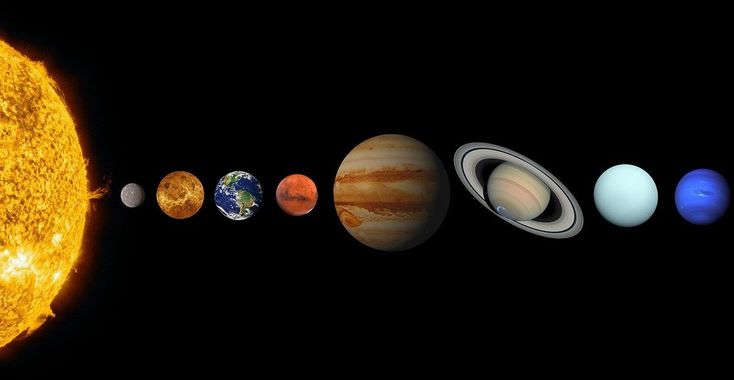
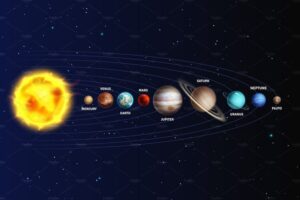
The image depicts an artistic representation of the solar system with the Sun at the center and all eight planets Mercury, Venus, Earth, Mars, Jupiter, Saturn, Uranus, and Neptune arranged in their orbital paths around it. The planets are shown in a straight line from the Sun, highlighting their relative sizes and colors against a stunning cosmic backdrop of stars and nebulae
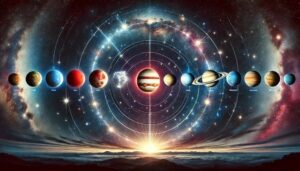
1. Planetary Order (from the Sun outward): Mercury → Venus → Earth → Mars → Jupiter → Saturn → Uranus → Neptune.
2. Key Features Shown
The Sun is illustrated with a glowing red halo emphasizing its central role.
Each planet is labeled and displayed with its characteristic color and texture.
Concentric white circles represent the planetary orbits, indicating their paths around the Sun
3. Astronomic Context: The alignment of all planets in a straight line is a rare theoretical configuration (often called “planetary alignment”), though in reality such perfect alignment does not occur naturally
4. Artistic Elements: The background showcases a dramatic cosmic scene with stellar formations and a sunrise at the horizon, adding a mystical atmosphere to the solar system depiction
The Solar System Sun & Eight Planets in Order (with Pluto)
The image shows an artistic lineup of the Sun and the eight planets of our solar system, arranged in order of their distance from the Sun (left to right). On the far right, Pluto is also included, traditionally considered a dwarf planet. The planets are depicted with their characteristic colors and features, giving a visual representation of the solar system’s layout
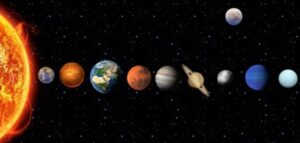
1. Order of the planets (from the Sun):
1. Mercury
2. Venus
3. Earth
4. Mars
5. Jupiter
6. Saturn (with its rings)
7. Uranus
8. Neptune
2. Additional body in the image:
Pluto (shown separately on the far right), classified as a dwarf planet by the International Astronomical Union (IAU)
3. Key facts:
The Sun contains >99% of the solar system’s mass
The four inner planets (Mercury–Mars) are rocky; the four outer planets (Jupiter Neptune) are gas giants
Pluto resides in the Kuiper Belt, a region of icy bodies beyond Neptune
The Solar System Planetary Alignment
The image shows an artistic illustration of our Solar System with the Sun on the left and the eight planets Mercury, Venus, Earth, Mars, Jupiter, Saturn, Uranus, and Neptune arranged in their orbital paths (white elliptical lines) around it. The planets are depicted in colorful, realistic textures and are spaced to represent their relative order from the Sun
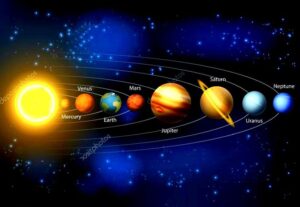
1. Planetary Order (from the Sun): Mercury → Venus → Earth → Mars → Jupiter → Saturn → Uranus → Neptune.
2. Planet Types:
Terrestrial (rocky): Mercury, Venus, Earth, Mars
Gas giants: Jupiter, Saturn
Ice giants: Uranus, Neptune
3. Key Features in the image:
The Sun is shown as a bright yellow-orange star at the center of the system.
Each planet’s orbit is illustrated with a white elliptical line indicating its path around the Sun
Saturn is highlighted with its prominent ring system
4. Astronomic Note:
The planets are never aligned in a straight line in reality; the image is an artistic representation for educational purposes
The Solar System Planetary Order & Arrangement
The image shows an illustrated view of our Solar System with the Sun on the left and the eight planets (plus dwarf planet Pluto) aligned along their orbital paths. The planets are arranged in order of their distance from the Sun: Mercury, Venus, Earth, Mars, Jupiter, Saturn, Uranus, and Neptune, with Pluto shown as a dwarf planet at the far right
1. Planetary Sequence (from the Sun):
Mercury
Venus
Earth
Mars
Jupiter
Saturn
Uranus
Neptune
Pluto (classified as a dwarf planet).
2. Key Features Shown:
The elliptical orbital paths (blue lines) indicate each planet’s revolution around the Sun.
Relative sizes of the planets are depicted visually, though not to exact scale.
Jupiter and Saturn are illustrated with their prominent ring systems (Saturn’s rings are more distinct).
3. Solar System Basics:
The Sun is the central star that provides heat and light to the planets.
The four inner planets (Mercury Mars) are terrestrial (rocky).
The four outer planets (Jupiter Neptune) are gas giants (Jupiter & Saturn) or ice giants (Uranus & Neptune)


Leave a Reply