


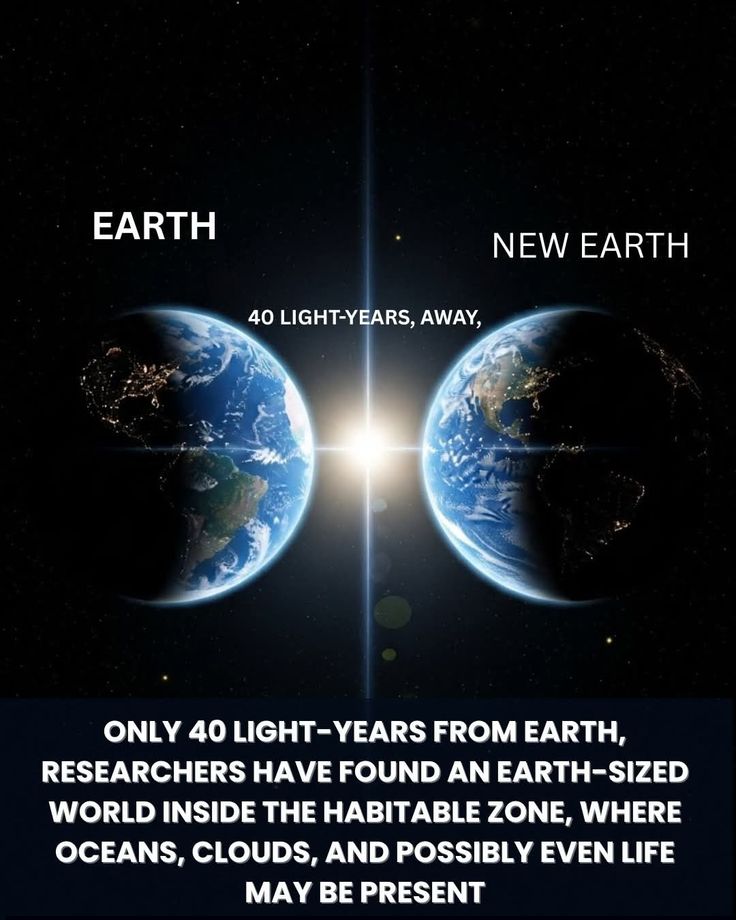
The image illustrates a newly discovered Earth‑sized planet located just 40 light‑years from our own Earth. The planet sits within its star’s habitable zone, the region where conditions may allow liquid water, oceans, and clouds to exist, raising the exciting possibility that life could thrive there
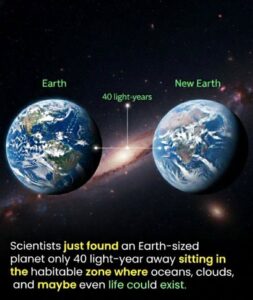
Distance: The exoplanet is approximately 40 light‑years from Earth.
Size: It is comparable in size to Earth.
Location: It orbits within the habitable (Goldilocks) zone of its star, meaning it receives the right amount of stellar energy for surface temperatures that could support liquid water.
Implications: Being in the habitable zone suggests the planet could have oceans, clouds, and potentially life‑supporting environments, making it a target for future astrobiological studies and observations.
Earth’s Twin: A New Earth‑Sized World 40 Light‑Years Away
The image shows a side‑by‑side comparison of our planet Earth (left) and a newly discovered Earth‑sized exoplanet labeled New Earth (right), separated by a glowing line that reads “40 LIGHT‑YEARS, AWAY.” The graphic highlights that this alien world lies within the habitable zone of its star, suggesting it may have oceans, clouds, and possibly even life
Distance: The exoplanet is approximately 40 light‑years from Earth.
Size & Location: It is Earth‑sized and orbits within the habitable (Goldilocks) zone of its star, where conditions allow liquid water to exist on the surface.
Features: Observations indicate the presence of oceans and cloud formations, similar to Earth’s climate system.
Potential for Life: Researchers speculate that the planet could host life, making it a prime target for astrobiological studies and future telescopic investigations.
Scientific Interest: The discovery fuels excitement about finding Earth‑like environments beyond our solar system and advances the search for extraterrestrial habitability.
Want to know more about the methods used to detect such exoplanets or the upcoming missions targeting habitable worlds 🪐🔭
Discovery of an Earth sized Exoplanet in the Habitable Zone, 40 Light‑Years Away
The image illustrates a recent astronomical find of a planet roughly the size of Earth located just 40 light‑years from our planet. This “new Earth” sits within its star’s habitable zone, the region where conditions could allow liquid water, clouds, and possibly even life to exist
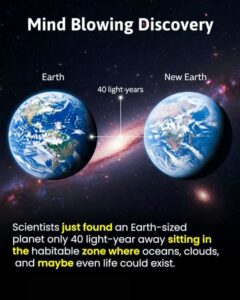
Planet characteristics: Earth‑sized, situated in the habitable (Goldilocks) zone of its star.
Distance: 40 light‑years from Earth.
Implications: The location suggests the planet may have oceans, cloud formations, and a climate suitable for life.
Scientific significance: The discovery fuels research into exoplanet habitability and the search for extraterrestrial life.
Want to know the name of this specific exoplanet or the method used for its detection
From Black‑and‑White Dawn to Crystal‑Clear View: The Evolution of Earth Photographs from Space (1946–2026)
The image presents a striking side‑by‑side comparison of the first ever photograph of Earth taken from space (1946) and the latest high‑resolution image of our planet captured in 2025. The top half shows a grainy, black‑and‑white snapshot that marked humanity’s initial glimpse of Earth from beyond the atmosphere. The bottom half displays a vivid, detailed color photograph showcasing modern imaging technology, highlighting continents, oceans, cloud patterns, and atmospheric effects with exceptional clarity
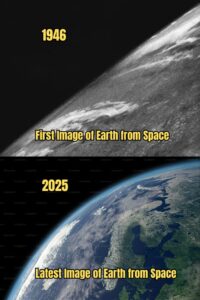
Information:
1. 1946 Image:
Captured by a V‑2 rocket launched by the United States (originally a German wartime missile).
Represents the pioneering “first” photo of Earth from space, demonstrating early space‑imaging capabilities.
The image is monochrome and low‑resolution due to the limited technology of the time.
2. 2025 Image:
Taken using advanced satellite or space‑borne imaging systems with high‑definition sensors.
Shows detailed surface features, atmospheric limb, and color‑accurate representation of Earth.
Reflects significant advancements in optics, digital imaging, and space observation over the past eight decades.
3. Significance:
The comparison illustrates the rapid progress in space photography and remote sensing technology.
It underscores humanity’s growing ability to monitor Earth’s environment, climate, and geography from space.
Want to know more about specific missions that captured these images or the technological breakthroughs behind modern Earth imaging
Total Liquid Water Comparison: Earth vs. Ganymede
The image contrasts the total volume of liquid water on Earth with that on Ganymede, Jupiter’s largest moon. It shows two planetary bodies side‑by‑side with their respective water quantities expressed in litres using scientific notation
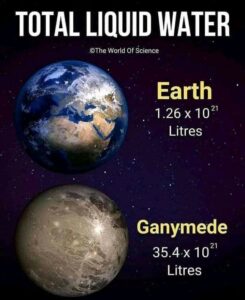
Earth: The total liquid water volume is approximately 1.26 × 10²¹ litres. This includes oceans, seas, lakes, rivers, and groundwater.
Ganymede: The total liquid water volume is estimated at 35.4 × 10²¹ litres, indicating Ganymede holds about 28 times more liquid water than Earth, primarily in subsurface oceans beneath its icy crust
Want to know more about how the water on Ganymede is distributed or its implications for astrobiology


Leave a Reply