


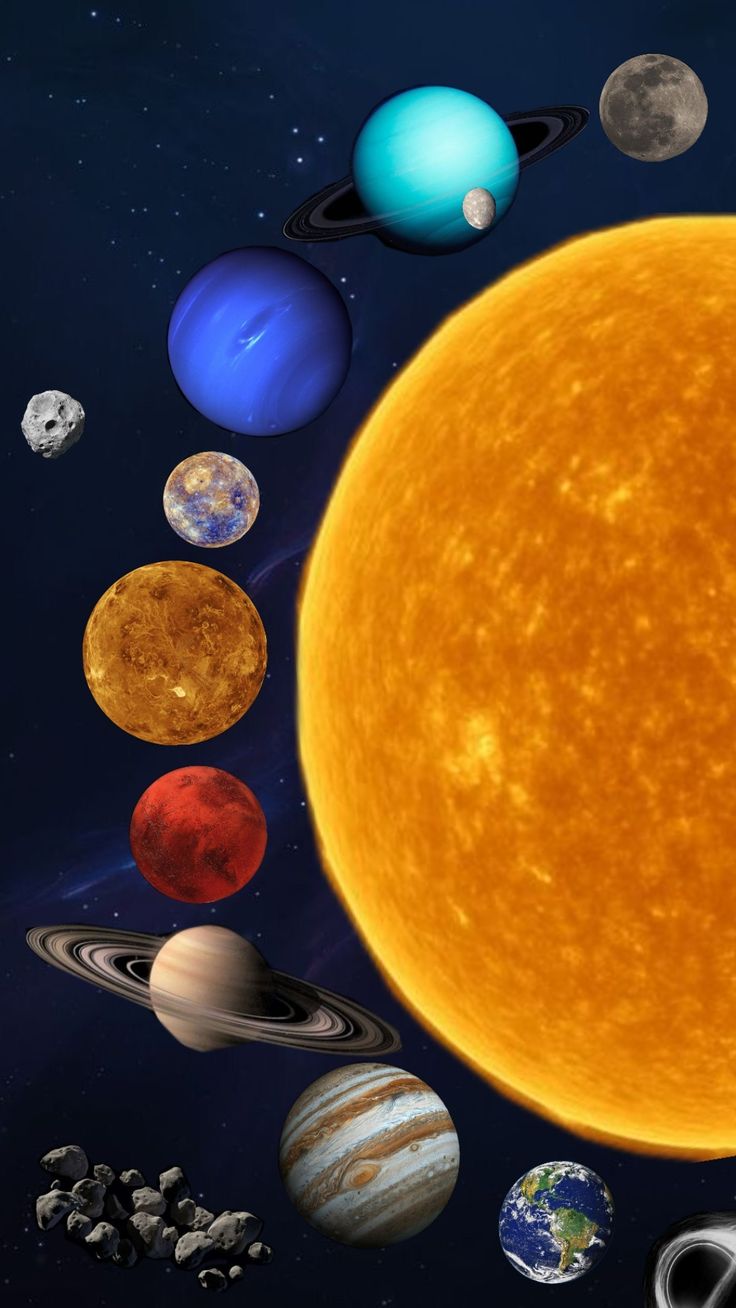
Journey Through the Solar System: A vibrant illustration of the Sun and its eight orbiting planets Mercury, Venus, Earth, Mars, Jupiter, Saturn, Uranus, and Neptune showcasing their elliptical paths and cosmic beauty in space.”
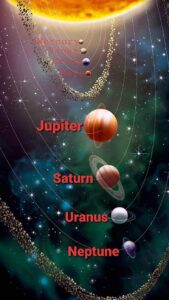
Explore the Solar System: Sun & eight planets in their orbital dance
Observe a total lunar eclipse under dark skies. March 3
“Two Nights You Can’t Miss!
Experience the awe-inspiring celestial events of the ‘Ring of Fire’ and the ‘Blood Moon Eclipse’.
On February 17, witness a rare annular solar eclipse, known as the ‘Ring of Fire’. In this spectacular phenomenon, the Moon passes directly between the Earth and the Sun, creating a glowing ring of sunlight around the dark silhouette of the Moon. The image captures this breathtaking moment against the backdrop of pyramids with camels in the foreground, highlighting the timeless allure of celestial wonders.
On March 3, observe a total lunar eclipse, the ‘Blood Moon Eclipse’, under dark skies. During this event, the Earth aligns perfectly between the Sun and the Moon, casting the Moon in a dramatic reddish hue. The striking red Moon is reflected in the water below, adding to the mystique of the eclipse.
Don’t miss these extraordinary astronomical events that promise unforgettable views of the cosmos in action!”
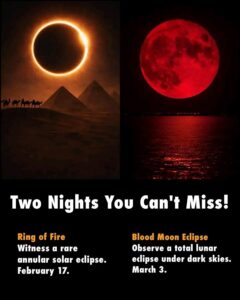
1. Ring of Fire
Event: A rare annular solar eclipse.
Date: February 17.
2. Blood Moon Eclipse
Event: A total lunar eclipse (the Moon appears red).
Date: March 3.
Journey Through Space: Exploring Our Solar System
This vibrant cosmic illustration showcases the eight planets of our solar system arranged in ascending order of size, floating dramatically against a star‑filled deep‑space background with Saturn proudly displaying its iconic rings. The image captures the awe‑inspiring diversity of planetary worlds from the fiery orange swirls of Jupiter to the icy blues of Neptune and invites viewers to explore the wonders of astronomy and the mysteries that lie beyond Earth. The bold white “Space” text anchors the scene, emphasizing the grandeur of the celestial realm and inspiring curiosity about planetary science, space exploration, and the universe’s vastness
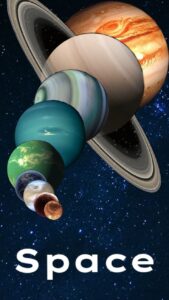
The planets are depicted (left to right, smallest to largest):
1. Mercury the tiny, cratered innermost planet.
2. Mars the red, dusty world known for its thin atmosphere.
3. Venus the thick‑clouded, white‑shaded planet often called Earth’s sister.
4. Earth our green‑blue home, shown with continental features.
5. Neptune the deep‑blue ice giant with strong winds.
6. Uranus the pale cyan planet with subtle ring hints and atmospheric bands.
7. Saturn the majestic gas giant famous for its extensive ring system.
8. Jupiter the massive orange‑striped planet, the largest in the solar system, featuring prominent storm patterns.
The arrangement highlights comparative planetary sizes and encourages educational exploration of orbital mechanics, atmospheric compositions, and the unique characteristics that make each world fascinating for astronomers and space enthusiasts alike
Solar System Showcase: The Sun & Eight Planets in Cosmic Harmony
This vibrant digital illustration presents the Sun and the eight planets of our solar system arranged diagonally against a star‑filled space backdrop. Starting from the upper left, the sequence features the blazing Sun, followed by the tiny Mercury, fiery Venus, blue‑green Earth paired with its reddish Moon, then Mars with its rusty hue. Moving downward, the lineup continues with massive Jupiter showcasing its swirling bands, elegant Saturn highlighted by its iconic rings, icy blue Neptune, and bright aqua Uranus at the bottom. The artwork captures the relative sizes and distinctive colors of each celestial body, celebrating the beauty and diversity of our cosmic neighborhood
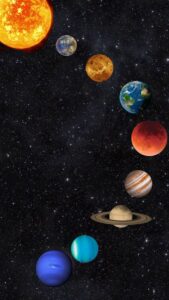
1. The Sun a massive orange‑yellow star that anchors the system and provides energy for all planets.
2. Mercury the smallest planet, shown as a grayish sphere closest to the Sun.
3. Venus an orange‑gold planet often called Earth’s sister due to its similar size.
4. Earth the blue‑green world with visible landmasses, positioned with its companion Moon (reddish sphere).
5. Mars the red planet known for its rocky, dusty surface.
6. Jupiter the largest gas giant, distinguished by orange‑white atmospheric bands.
7. Saturn a beige gas giant famed for its bright, detailed ring system.
8. Uranus an aqua‑blue icy planet with subtle cloud features.
9. Neptune a deep blue icy giant displaying atmospheric swirls.


Leave a Reply