


The image presents an artistic, detailed illustration of the solar system centered around a brilliant, glowing Sun that emits intense yellow‑orange light. Concentric orbital paths (ellipses) are depicted to show the motion of the eight planets Mercury, Venus, Earth, Mars, Jupiter, Saturn, Uranus, and Neptune as they revolve around the Sun. The planets are rendered with characteristic features (e.g., Saturn’s rings, Mars’ reddish hue). Annotated labels and scientific data are scattered throughout the scene, highlighting physical properties, orbital mechanics, and energetic interactions within the system. The overall design blends educational infographics with cosmic visualization, emphasizing the Sun’s dominance in governing planetary motion and energy distribution.
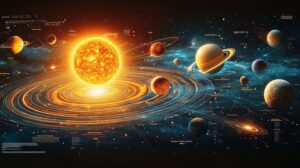
1. Central Star: Sun primary energy source, depicted with radiant texture.
2. Planetary Arrangement: Eight planets shown with their elliptical orbits and relative sizes.
3. Visual Elements: Orbital lines, glowing effects, and labeled annotations for scientific data.
4. Educational Focus: Illustration serves as an infographic explaining solar system
Celestial Wanderer Gazing at the Golden Ringed Cosmos

The image depicts a lone silhouette of a person standing on a rugged, rocky outcrop, looking out at an awe‑inspiring cosmic scene. A massive, glowing orange planet dominates the left side of the sky, surrounded by sweeping, luminous ring‑like orbital paths that weave through several smaller planets and celestial bodies toward a bright star on the right. The atmosphere conveys a sense of wonder, exploration, and the infinite mystery of the universe, blending realistic mountainous terrain with fantastical astronomical elements
– Scene setting: Mountainous landscape with a solitary observer.
– Main celestial element: Large orange planet with atmospheric swirls.
– Secondary elements: Multiple planets and a shining star embedded in radiant orbital streaks forming a cosmic “ring” effect.
– Mood & theme: Contemplation of space, cosmic beauty, and existential wonder.
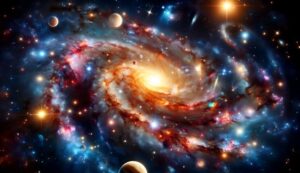
“Cosmic Whirl: A Luminous Spiral Galaxy”
– The galaxy exhibits a bright central bulge surrounded by spiral arms rich in young blue stars and reddish nebular regions where star formation occurs.
– Spiral galaxies like this one contain billions of stars and are classified by their distinct arm structure (e.g., Sa, Sb, Sc types).
– The glowing core indicates an active region, possibly hosting a supermassive black hole.
– The surrounding celestial bodies (planets or moons) in the image are artistic additions highlighting the galaxy’s grandeur in space.
– Such galaxies are key subjects in astrophysics for studying stellar evolution, galactic dynamics, and cosmic structure
The Solar System Planetary Orbits Around the Sun
The image depicts an artistic representation of our Solar System, showing the Sun at the center with eight planets and the asteroid belt orbiting it along elliptical paths. The planets are arranged in order of their distance from the Sun: Mercury, Venus, Earth, Mars, Jupiter, Saturn, Uranus, and Neptune. The white elliptical lines illustrate each planet’s orbital trajectory. The asteroid belt, located between Mars and Jupiter, is also shown with numerous rocky bodies. The background features a starry cosmic space with distant galaxies, emphasizing the system’s place in the universe
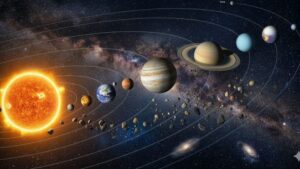
1. Planets (in order from the Sun): Mercury, Venus, Earth, Mars, Jupiter, Saturn, Uranus, Neptune.
2. Key features in the image: Sun, planetary orbits, asteroid belt, and surrounding cosmic environment.
3. Scientific note: The illustration simplifies actual orbital mechanics but conveys the relative sizes and positions of the celestial bodies in the Solar System.


Leave a Reply