


On February 28, 2026, the western sky shortly after sunset will host a rare and captivating six-planet alignment; Mercury, Venus, Saturn, Jupiter, Uranus, and Neptune; appearing strung along the ecliptic in a stunning celestial parade visible to observers with clear western horizons.
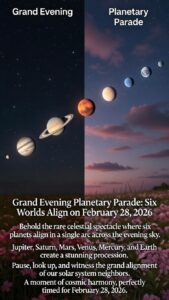
This “planetary parade” occurs when multiple planets project along the same section of sky from Earth’s perspective, following the ecliptic; the apparent path of the Sun (and planets) across our sky due to the solar system’s roughly flat orbital plane. While the planets are never in a perfect straight line in three-dimensional space, their positions create the illusion of a graceful arc across the twilight. Venus and Jupiter dominate as brilliant beacons, Saturn adds a steady golden glow, Mercury challenges observers low near the horizon, and the faint ice giants Uranus and Neptune reward those with binoculars or a small telescope. The alignment reaches its most compact and photogenic form around February 28 but remains impressive for several days around that date. With the Moon absent or very thin (waning crescent low in the west), the sky stays dark enough for fainter objects. If weather cooperates, this is one of the most accessible multi-planet gatherings of the year; perfect for casual stargazers, photographers, and astronomy enthusiasts alike
The Ecliptic and Why Planets Appear to Line Up
The ecliptic is the great circle on the celestial sphere that marks the Sun’s annual path. Because all major planets orbit the Sun in nearly the same plane (within a few degrees), they appear to travel along or very close to this line from our viewpoint. When several planets cluster in the same zodiacal region, they form a visible “parade” or alignment.
In late February 2026, the configuration favors evening visibility: inner planets Mercury and Venus stay close to the Sun (evening “stars”), while outer planets Jupiter, Saturn, Uranus, and Neptune spread higher across the southwest to south. The result is a wide but dramatic arc rising in the west after sunset
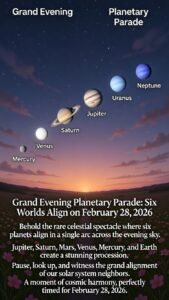
Such alignments recur periodically as faster inner planets overtake slower outer ones from our perspective. This particular six-planet evening display stands out for including both dazzling naked-eye worlds and the challenging ice giants
How the February 28 Alignment Appears
About 30–60 minutes after sunset, when twilight deepens but low planets remain above the horizon:
- Venus: Blazes at magnitude ~–4.0 as the “evening star,” low in the west; impossible to miss.
- Mercury: Fainter (~magnitude 0 to –1), very low near Venus; challenging in twilight but catchable early; use Venus as a guide.
- Saturn: Steady golden glow (~magnitude 0.7), higher than Mercury/Venus; easy naked-eye target
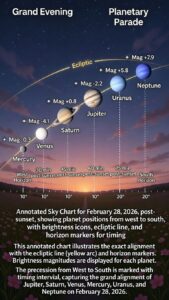
- Neptune: Dim (~7.8 magnitude), near Saturn; binoculars reveal a faint blue dot.
- Uranus: Modest (~5.7 magnitude), higher near the Pleiades; binoculars show it as a greenish point; small telescope resolves a tiny disk.
- Jupiter: Brilliant (~–2.4 magnitude), prominent higher up; second-brightest point after Venus, with Galilean moons visible in scopes.
The arc spans wide (not tight), from horizon to mid-sky. Visibility varies by latitude; clear, unobstructed west ideal; light pollution dims fainter ones
Viewing Tips for Maximum Enjoyment
To catch the full parade:
- Wait 30 60 minutes after sunset; twilight must fade for Mercury and fainter planets.
- Find a clear western/southwestern horizon; no hills, buildings, or trees blocking low views.
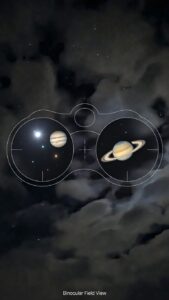
- Use binoculars (7×50 or 10×50 recommended) for Uranus and Neptune; they fit multiple planets in one field.
- Small telescope enhances details: Jupiter’s bands, Saturn’s rings (tilted modestly), Uranus/Neptune as tiny disks.
- Dark site away from city lights boosts contrast; rural or elevated spots best.
- Check apps (Stellarium, SkySafari) for exact local positions and set times.
- Weather clear? Dress warm; nights cool during long watches.
Challenges: Twilight glare hides low Mercury/Venus; haze or clouds common; try nearby dates if obstructed
Why This Parade Captivates; and Broader Cosmic Ties
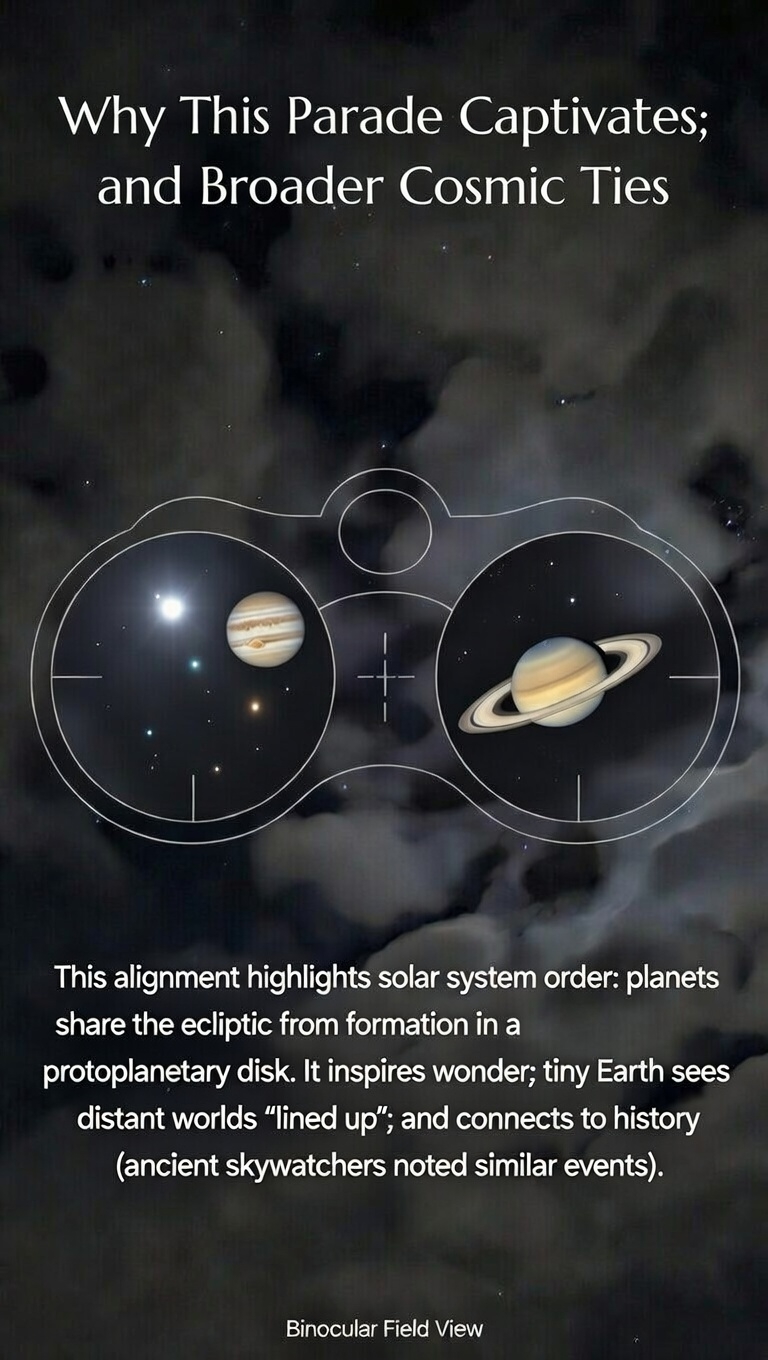
This alignment highlights solar system order: planets share the ecliptic from formation in a protoplanetary disk. It inspires wonder; tiny Earth sees distant worlds “lined up”; and connects to history (ancient skywatchers noted similar events).
Scientifically, such views aid amateur tracking, orbital studies, or even exoplanet analogies (transits). In 2026’s busy year (eclipses, other parades), this evening show stands accessible and photogenic
Gather friends/family; lie back or stand with binoculars. The planets’ slow drift reminds us of vast scales and graceful motion.
As February 28 nears, prepare your spot. Whether spotting four naked-eye gems or hunting the faint duo, the experience fosters awe. The solar system parades nightly; tonight, six join the line. Look up, share the view, and embrace the wonder of our cosmic neighborhood. Tag your stargazing friends and get ready for an unforgettable night under the stars! Clear skies and stellar sights await!


Leave a Reply