


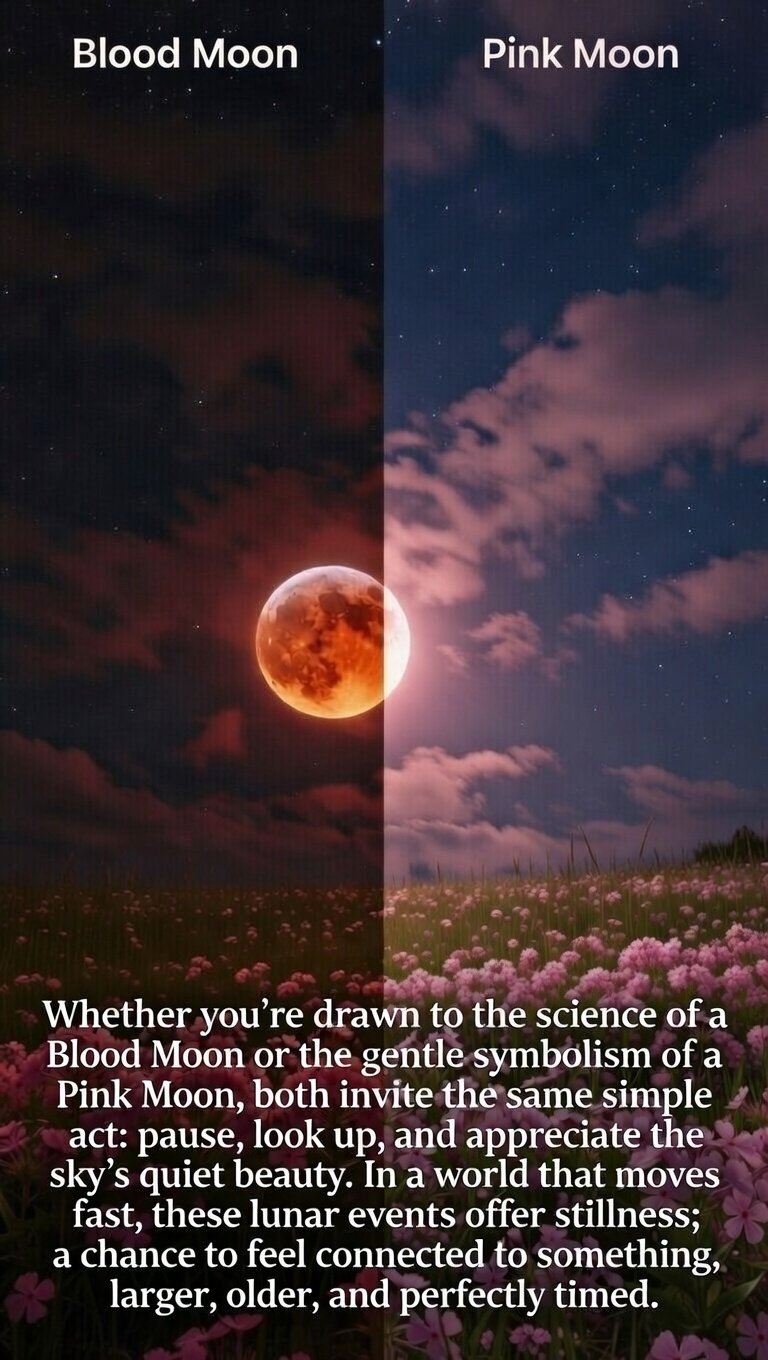
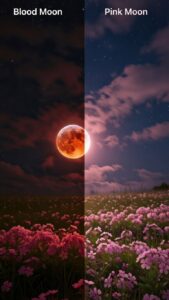
The coming months bring two captivating full Moon events that capture the imagination in very different ways: the dramatic “Blood Moon” of a total lunar eclipse and the gentle, tradition-rich “Pink Moon” of April; each reminding us of the Moon’s timeless role as both a scientific marvel and a symbol of renewal
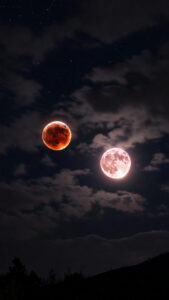
First, the Blood Moon emerges during a total lunar eclipse, when Earth aligns perfectly between the Sun and the full Moon, casting its shadow across the lunar surface. Rather than vanishing into darkness, the Moon transforms into a deep reddish-orange orb. This striking color occurs because sunlight passing through Earth’s atmosphere scatters shorter blue wavelengths while allowing longer red wavelengths to bend and reach the Moon; essentially bathing it in the combined glow of every sunrise and sunset happening simultaneously on our planet. The result is a haunting “blood” hue that can range from coppery to brick-red, depending on atmospheric conditions like dust, volcanic aerosols, or pollution. Totality; the phase when the Moon is fully immersed in Earth’s umbra; often lasts 30 60 minutes, giving ample time to witness the slow, mesmerizing shift from partial shading to complete red immersion.
In contrast, the Pink Moon carries no actual pink tint. It is the traditional name given to April’s full Moon in many Native American, colonial American, and European folk calendars. The name honors the blooming of early spring wildflowers; particularly the moss pink (Phlox subulata); that carpet the ground with delicate pink blossoms around this time. Far from a color change, the Pink Moon symbolizes renewal, growth, fertility, and the arrival of warmer seasons after winter’s dormancy. It arrives when nature awakens, plants push through soil, and animals prepare for new life; a quiet celebration of Earth’s annual rebirth.
Both events invite us to pause and look upward. One reveals the precise mechanics of our atmosphere and orbital geometry; the other connects us to ancient seasonal rhythms and cultural storytelling. Together, they highlight the Moon’s dual nature: a cold, cratered rock 384,400 km away, yet a source of enduring wonder, myth, and quiet inspiration
The Science Behind the Blood Moon
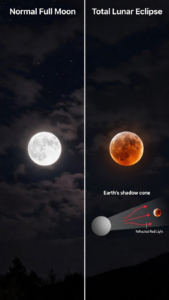
A total lunar eclipse requires three bodies in near-perfect alignment: Sun–Earth–Moon. Earth’s shadow has two parts:
- Penumbra: Faint outer shadow → gradual dimming.
- Umbra: Dark central shadow → totality when the Moon enters fully.
During totality, direct sunlight is blocked, but refracted red light from Earth’s atmospheric rim reaches the Moon. The longer the path through the atmosphere (near the edge of the umbra), the redder the hue. Volcanic eruptions or heavy dust can darken the Moon dramatically (as in 1991–1992 after Mount Pinatubo), while clear air yields brighter copper tones
Eclipses follow the Saros cycle (~18 years 11 days), so patterns repeat predictably. Recent years have seen several totals; the next widely visible one arrives soon; mark your calendar and prepare for a night of red-lit wonder
The Tradition and Meaning of the Pink Moon
The Pink Moon name comes from Algonquin, Cherokee, and other Indigenous calendars, where months were named for natural events rather than numbers. April’s full Moon coincides with the emergence of phlox, wild ground phlox, and other pink spring flowers across eastern North America; heralding the end of frost and the start of planting season.
Other names for April’s full Moon include:
- Sprouting Grass Moon
- Egg Moon
- Fish Moon
- Seed Moon
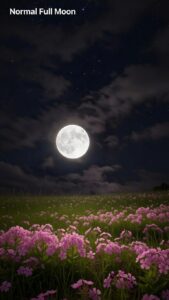
In many cultures, it represents hope, fertility, and new beginnings. Farmers used it as a planting guide; spiritual traditions associate it with rebirth, balance, and setting intentions for growth.
Unlike the Blood Moon, the Pink Moon looks like any other full Moon; bright and silvery-white. Its power lies in symbolism and seasonal timing, not visual transformation
Why These Lunar Events Matter
Why These Lunar Events Matter
The Blood Moon captivates through science and drama; three celestial bodies aligning to create a global spectacle of reflected sunsets. The Pink Moon touches the heart through tradition and seasonality; quietly marking Earth’s awakening after winter.
Together, they remind us:
- The universe operates on vast, predictable cycles.
- Our atmosphere can paint the Moon red from 384,400 km away.
- Ancient cultures named full Moons after nature’s rhythms, linking sky to seasons.
- Even without color change, a full Moon in spring feels like a promise of new life.
These moments need no telescope or filter; just clear skies and a willingness to look up
Step Outside and Take It In
Whether you’re drawn to the science of a Blood Moon or the gentle symbolism of a Pink Moon, both invite the same simple act: pause, look up, and appreciate the sky’s quiet beauty. In a world that moves fast, these lunar events offer stillness; a chance to feel connected to something larger, older, and perfectly timed.


Leave a Reply