


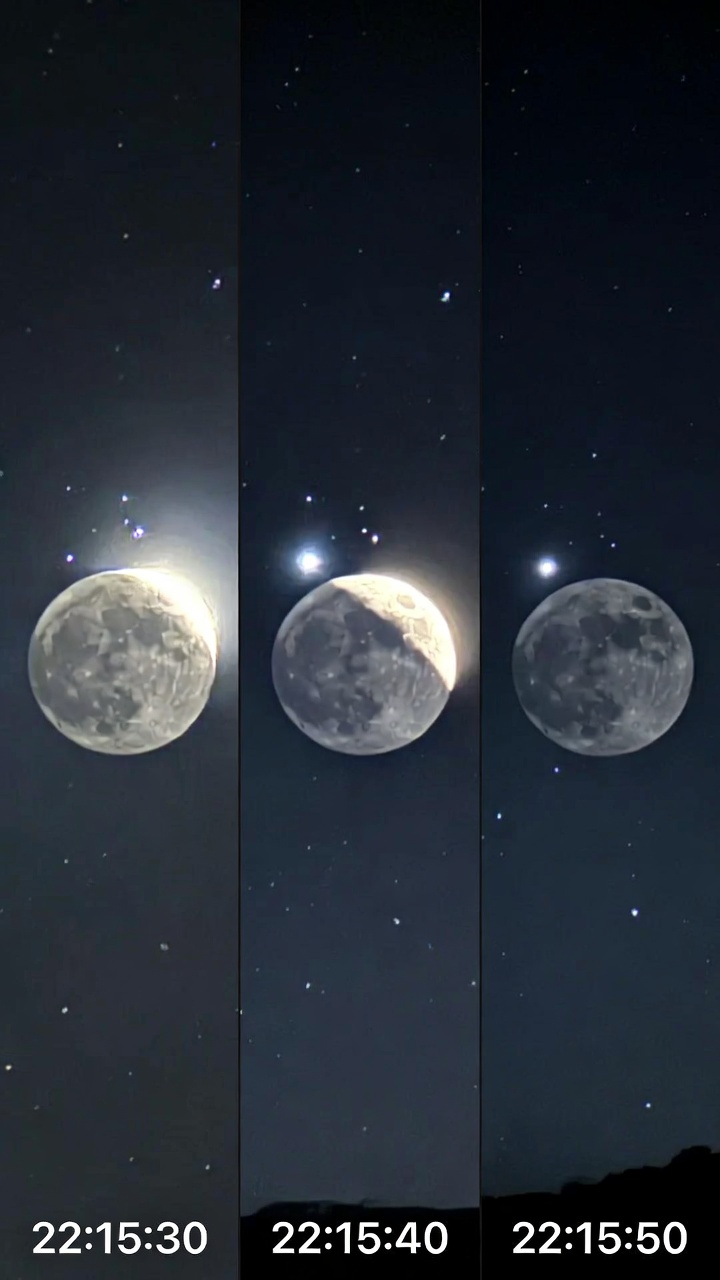
On the evening of February 24, 2026, a slender waxing crescent Moon; about 38% illuminated; glides close to the Pleiades, the dazzling open star cluster known as the Seven Sisters, creating one of the most picturesque lunar pairings of the year in the evening sky
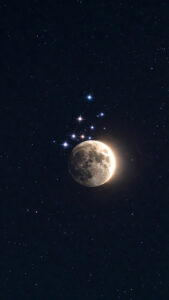
This beautiful celestial encounter places the Moon’s soft silvery glow just a few degrees from the sparkling blue-white jewels of the Pleiades (M45), producing a striking contrast: The Moon’s gentle arc beside a tiny, glittering diamond-like group of stars. Visible to the naked eye from virtually anywhere with a clear western to southwestern view after sunset, the scene becomes even more enchanting through binoculars or a small telescope, which reveal dozens of additional faint cluster members and the Moon’s detailed craters along the terminator. For observers in North America, Central America, and the Caribbean, the Moon may briefly occult (cover) several of the brighter Pleiades stars, adding a touch of drama as stars wink out behind the lunar disk and reappear minutes later. Best seen from late evening through midnight when the pair reaches its highest point, this event offers a serene, accessible wonder; no special equipment required, just clear skies and a moment to look up
The Pleiades: A Timeless Treasure of the Night Sky
The Pleiades (M45) is one of the closest and brightest open star clusters to Earth, lying about 440 light-years away in the constellation Taurus. Often called the Seven Sisters in mythology; representing the daughters of Atlas and Pleione from Greek lore; the cluster actually contains hundreds of stars, though only six to nine are typically visible to the naked eye under dark skies.
The brightest members; Alcyone, Atlas, Electra, Maia, Merope, Taygeta, Celaeno, and others; are hot, young B-type stars only 100–150 million years old, still wrapped in faint wisps of the reflection nebula that gave birth to them. This nebulosity scatters blue light, giving the Pleiades their characteristic soft blue glow in photographs and through telescopes
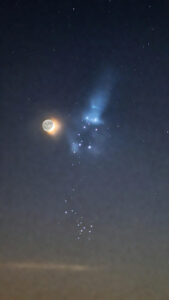
Culturally, the Pleiades have inspired stories across civilizations: winter arrival signals for Indigenous groups, navigation aids for Polynesian voyagers, and seasonal markers in Japanese, Chinese, and Aboriginal Australian traditions. Their name even appears in ancient literature, from Hesiod to the Bible
Lunar Occultation and Close Approach Details
The Moon moves eastward against the stars at about 0.5° per hour. On February 24, it passes within ~1–3° of the Pleiades center (exact separation varies by observer location and time).
- Best viewing window: Late evening to around midnight; when the pair is highest and the sky darkest.
- Naked-eye view: Striking even without aid; the Moon’s bright crescent frames the tiny glittering group, creating a poetic “Moon cradling the Seven Sisters” effect
- Binoculars (7×50 or 10×50): Reveal dozens more faint stars in the cluster and enhance the Moon’s earthshine on the dark side.
- Small telescope: Shows individual Pleiades stars as brilliant points and the Moon’s craters in sharp detail along the lit edge.
For viewers in North America, Central America, and the Caribbean, the Moon’s dark limb may occult several brighter Pleiades stars (notably Alcyone, Maia, Electra, and others) for 30–90 minutes depending on exact position. Stars disappear behind the Moon and reappear on the bright limb; watch for gradual fading and sudden re-emergence. Southern U.S. states and Mexico offer the best occultation geometry; northern areas see a very close miss
Why This Pairing Captivates Stargazers
Lunar passages near bright clusters or stars happen monthly, but few match the Pleiades for sheer visual poetry. The contrast; soft crescent against a compact jewel-box of blue-white stars; creates an almost artistic composition. The 38% illumination keeps the Moon bright enough to dominate yet not overpower the cluster’s delicate sparkle
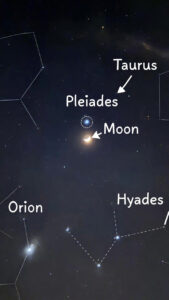
This event also highlights perspective: The Moon, just 384,000 km away, shares the sky with stars’ hundreds of light-years distant, united only by alignment from our viewpoint. It’s a gentle reminder of scale; our nearest neighbor momentarily framing a nursery of young stars born when dinosaurs still roamed.
For photographers, wide-angle lenses capture the scene beautifully against twilight gradients or foreground landscapes. For casual observers, it’s simply a moment of quiet aw
Tips for Enjoying the February 24 Celestial Meeting
To make the most of the night:
- Time it: Late evening through midnight; Moon highest, sky darkest.
- Location: Clear western to southwestern view after sunset; elevated spots help.
- Equipment: Naked eye for the overall scene; binoculars for extra stars and color; telescope for lunar details.
- Dark adaptation: Spend 15–20 minutes away from lights.
- Weather check: Clear skies essential; use apps like Clear Outside or Scope Nights.
- Share it: Invite friends or family; the shared wonder doubles the magic
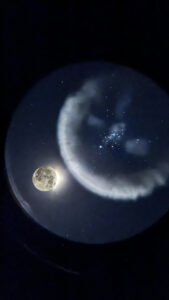
If clouds block the view, the Moon returns to Taurus roughly monthly; though rarely this close with such a favorable crescent phase.
A Night of Quiet Cosmic Beauty
In a year filled with eclipses, conjunctions, and planetary parades, this Moon-Pleiades encounter offers something softer: no drama, just serene elegance. A crescent Moon and ancient star


Leave a Reply