


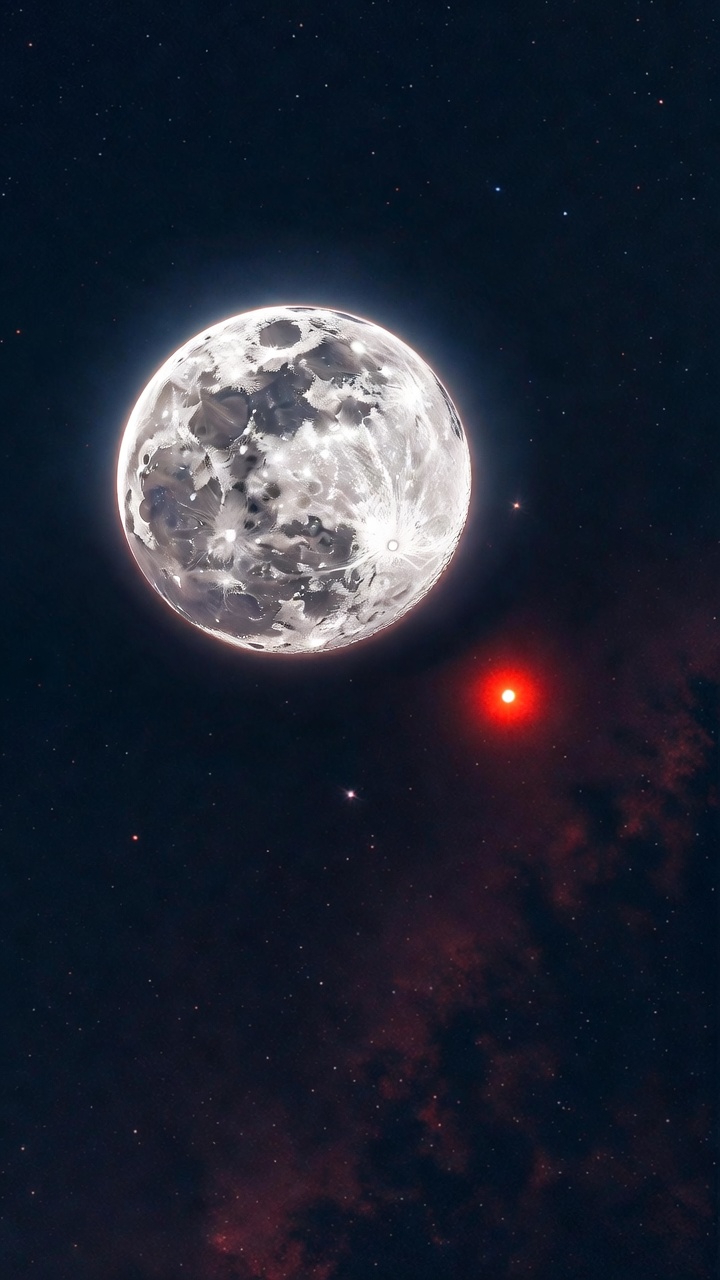
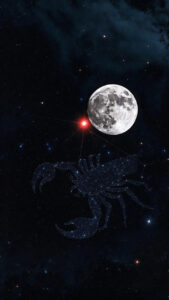
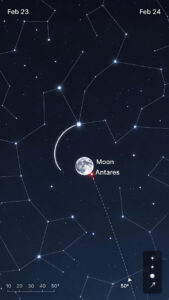
Late on February 23 into the early hours of February 24, 2026, the waxing gibbous Moon glides close to Antares; the brilliant red-orange supergiant that marks the fiery heart of Scorpius; creating a breathtaking color contrast that lights up the southeastern to southern sky in one of the most visually arresting lunar pairings of the year
This close approach (an occultation or very near conjunction depending on exact location) brings the Moon’s soft, silvery glow within just a few degrees of Antares’ deep, ruddy light, producing a vivid interplay of cool white and warm red tones visible to the naked eye. Binoculars or a small telescope enhance the scene dramatically: Antares’ intense color pops against the Moon’s subtle craters and maria, while the surrounding stars of Scorpius add depth to the view. Best seen from late evening through pre-dawn, the pairing reaches its closest point around 2–4 a.m. local time in many regions (exact separation varies slightly by observer position). No special equipment is required; just step outside, find a clear view toward the southeast or south, and let the night sky deliver its quiet, powerful beauty. In a month filled with eclipses and alignments, this serene lunar-stellar encounter offers a peaceful reminder of perspective: two objects separated by hundreds of light-years appear side by side, united only by our line of sight
The Moon’s Journey and the Occultation/Conjunction Details
The Moon orbits Earth every 27.3 days, moving roughly 13° eastward against the background stars each day. On February 23–24, it crosses into Scorpius during its waxing gibbous phase (~70–80% illuminated), passing close to Antares in the constellation’s distinctive “J” shape.
- Separation: The Moon approaches within ~1–3° of Antares (exact minimum depends on your latitude and longitude; closer for southern observers).
- Timing: Closest approach occurs in the pre-dawn hours for most Northern Hemisphere locations, with the Moon rising in the southeast after midnight and climbing toward the south by dawn.
- Visibility: Naked-eye stunning; binoculars reveal Antares’ vivid color and the Moon’s textured surface; a telescope shows Antares as a tiny, intensely red point beside the vast lunar disk
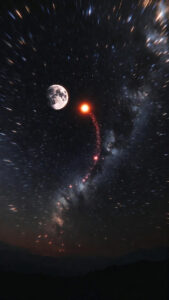 From many mid-northern latitudes, the Moon may occult (cover) Antares briefly for observers farther south, but even without occultation the visual effect remains spectacular; the Moon’s bright glow contrasting sharply with Antares’ ruddy hueMeet Antares: The Red Supergiant Heart of Scorpius
Antares (α Scorpii) is one of the sky’s most striking stars; a massive red supergiant roughly 12–15 times the Sun’s mass and 700–800 times its diameter. If placed at the Sun’s position, Antares would extend beyond the orbit of Mars
- Distance: Approximately 550–600 light-years.
- Brightness: Magnitude ~1.0 (variable; it occasionally outshines nearby stars), appearing deep red-orange due to its cool surface temperature (~3,500 K).
- Status: Late in life, Antares has exhausted core hydrogen and is fusing heavier elements in its core. It is destined to explode as a supernova within the next ~100,000 years; though from 550 light-years away, the blast would be spectacular but harmless.
The name “Antares” means “rival of Ares” (Mars), reflecting its similar red color to the planet. Tonight, the Moon provides a perfect side-by-side comparison: the silvery Moon versus Antares’ fiery glow
Why This Pairing Feels So Powerful
Lunar close approaches to bright stars happen monthly, but few match the drama of Antares due to its intense color and Scorpius’ striking pattern. The contrast; cool white Moon against hot red star; creates an almost painterly effect, amplified by the Moon’s phase (bright enough to illuminate the scene without washing out Antares
 This event also reminds us of perspective in astronomy: Antares lies hundreds of light-years away, its light left during the time of ancient civilizations, yet tonight it appears shoulder-to-shoulder with our nearest celestial neighbor. The vast distances collapse into a single, intimate view.
For photographers, the pairing offers excellent wide-angle opportunities; capture the Moon and Antares framed by Scorpius’ curving tail against a dark sky
Tips for Enjoying the February 23–24 Sky Show
To make the most of the moment:
- Time it right: Best from late night (after midnight) into pre-dawn; Moon highest and darkest sky around 2–5 a.m. local time.
- Find a clear southern/southeastern view: Avoid city lights and obstructions; rural or elevated spots ideal.
- Use binoculars: Enhance Antares’ color and reveal fainter Scorpius stars.
- Small telescope: Zoom in on Antares’ ruddy hue and the Moon’s craters along the terminator.
- Dark adaptation: Give your eyes 15–20 minutes away from lights.
- Check weather and Moon position with apps (Stellarium, SkySafari) for your exact spot.
If clouds intervene, the MoonAntares pairing repeats roughly monthly as the Moon cycles through Scorpius; though rarely this close or at such a favorable phase
 A Quiet Night of Cosmic Beauty
In a season packed with eclipses, conjunctions, and alignments, this lunar visit to Antares offers something different: calm, contemplative wonder. No dramatic flash or rarity; just two ancient lights, one reflected sunlight and one self-luminous fusion, appearing side by side in peaceful contrast.
Step outside tonight or in the early hours of February 24. Breathe the cool air, look southeast or south, and let the Moon and Antares share the sky. The universe rarely needs to shout; sometimes it simply glows softly and waits for us to notice.
Who’s looking up? Moments like this remind us how vast the cosmos is, yet how intimate it can feel under a clear night sky. Clear horizons, steady eyes, and enjoy the celestial heart-to-heart.


Leave a Reply