


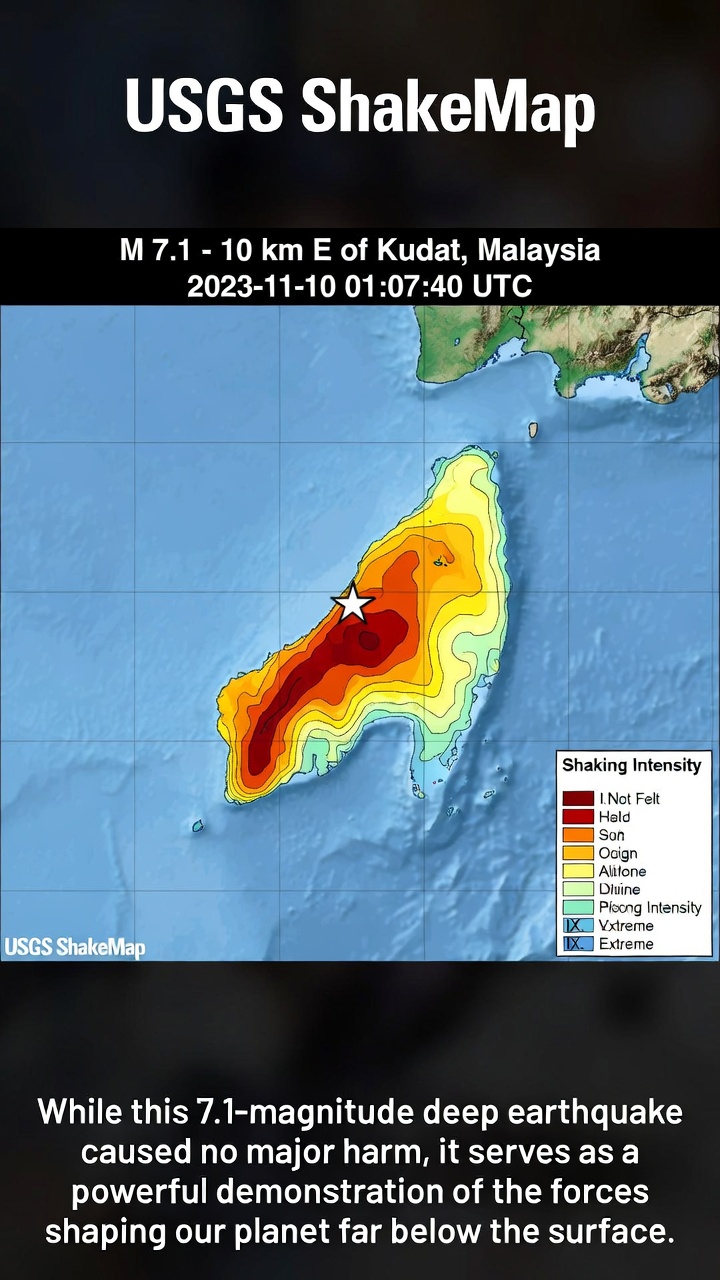

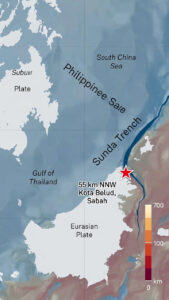
Early Monday morning on February 23, 2026, a major 7.1-magnitude earthquake rattled the region off the coast of Sabah in eastern Malaysia, according to the U.S. Geological Survey (USGS)a deep-focus tremor centered roughly 55 km north-northwest of Kota Belud on Borneo Island, at an unusually great depth of approximately 620 km (385 miles).
The quake struck at 00:57 local time (approximately 16:57 UTC on February 22), registering as one of the strongest events recorded near Malaysia in decades due to its combination of high magnitude and extreme focal depth. Because the hypocenter lay so far beneath the Earth’s surface in the lower mantle or upper transition zone seismic energy dissipated significantly before reaching the surface. Scientists emphasize that such deep earthquakes rarely generate tsunamis, as they lack the shallow crustal displacement needed to displace large volumes of ocean water. No tsunami warning has been issued by Malaysian authorities or the Pacific Tsunami Warning Center, and initial assessments indicate minimal surface impact.
Shaking was felt across parts of Sabah, particularly in coastal and northern areas, with lighter tremors reported in nearby regions of Borneo. Local monitoring agencies, including the Malaysian Meteorological Department (Met Malaysia), continue to track aftershocks and evaluate infrastructure. As of the latest updates, there are no confirmed reports of serious structural damage, injuries, or casualties consistent with the low expected risk from deep-focus events. Officials urge calm while advising residents to stay informed through official channels.
This event highlights the complex tectonics beneath Borneo and serves as a reminder of the planet’s restless interior, even in areas not typically associated with frequent strong quakes.
The Science Behind Deep-Focus Earthquakes
Earthquakes are classified by depth: shallow (<70 km), intermediate (70–300 km), and deep (>300 km). The Sabah quake falls firmly in the deep category, with its hypocenter around 620 km placing it in the upper mantle transition zone near the 660 km discontinuity.
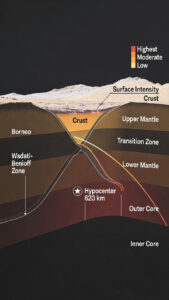
Deep-focus quakes occur within sub ducting slabs of oceanic lithosphere that have sunk into the mantle after being consumed at convergent plate boundaries. In Southeast Asia, the complex interplay of the Sunda Trench subduction zone (where the Indo-Australian Plate dives beneath the Eurasian Plate) and regional microplates drives such activity. The slab beneath northern Borneo remains cold and brittle enough to fracture violently even at great depths, releasing energy in a sudden snap.
The Wadati–Benioff zonethe inclined plane of earthquake foci marking a sub ducting slab extends beneath Sabah and explains why deep quakes can occur far from the trench itself. At 620 km, temperatures and pressures transform rock behavior, yet phase changes and dehydration reactions can still trigger brittle failure.
Because energy spreads over a larger volume before reaching the surface, deep quakes produce less intense shaking than shallow ones of similar magnitude. Buildings rarely collapse, and landslides or surface ruptures are uncommon explaining the absence of major damage reports so far.
Regional Tectonic Context and Historical Comparison
Sabah sits on the eastern edge of the Eurasian Plate, influenced by distant subduction along the Manila Trench to the northwest and the Sulu Sea spreading center. While shallow quakes and tsunamis are more common along the Sunda Arc (Indonesia, Philippines), deep-focus events occasionally strike farther inland.
Notable past deep quakes in the region include the 2015 6.0 Celebes Sea event (~600 km deep) and occasional 6+ magnitude tremors beneath Mindanao or northern Borneo. A 7.1 at 620 km depth ranks among the strongest recorded near Malaysia in modern instrumental history, though its depth limited surface effects.
Globally, deep-focus quakes above magnitude 7 are rare but not unprecedentedthe 2013 Okhotsk Sea 8.3 quake (609 km deep) remains the largest ever recorded at such depth.
Immediate Impacts, Monitoring, and Safety Guidance
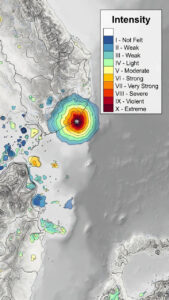
Initial reports from Met Malaysia and USGS indicate Modified Mercalli intensities reached IV–V (light to moderate shaking) in northern Sabah, with weaker tremors felt farther afield. No major infrastructure damage, landslides, or casualties have been confirmed, aligning with expectations for deep events.
Authorities continue monitoring for aftershocks, though deep-focus quakes typically produce fewer and smaller follow-ups compared to shallow ruptures. Residents are advised to:
- Stay updated via official channels (Met Malaysia, local government alerts).
- Inspect homes for minor cracks or shifted items.
- Prepare an emergency kit as standard precaution.
- Avoid spreading unverified rumors rely on verified sources.
The event underscores the importance of earthquake-resistant building codes and public awareness, even in low-frequency seismic zones.
A Reminder of Earth’s Dynamic Interior
While this 7.1-magnitude deep earthquake caused no major harm, it serves as a powerful demonstration of the forces shaping our planet far below the surface. Sub ducting slabs plunge hundreds of kilometers, carrying cold, brittle material into the hot mantle yet still capable of sudden, energetic failure.
Such events, though infrequent near Malaysia, remind us that seismic activity occurs globally and at all depths. They fuel scientific study of mantle dynamics, subduction processes, and deep earthquake mechanisms insights that ultimately improve hazard assessment worldwide.
As monitoring continues and aftershock risk is evaluated, the Sabah quake of February 23, 2026, stands as a testament to Earth’s restless interior quietly powerful, rarely destructive at such depths, yet always worthy of respect and attention. Stay safe, stay informed, and keep watching the ground beneath our feet.


Leave a Reply