


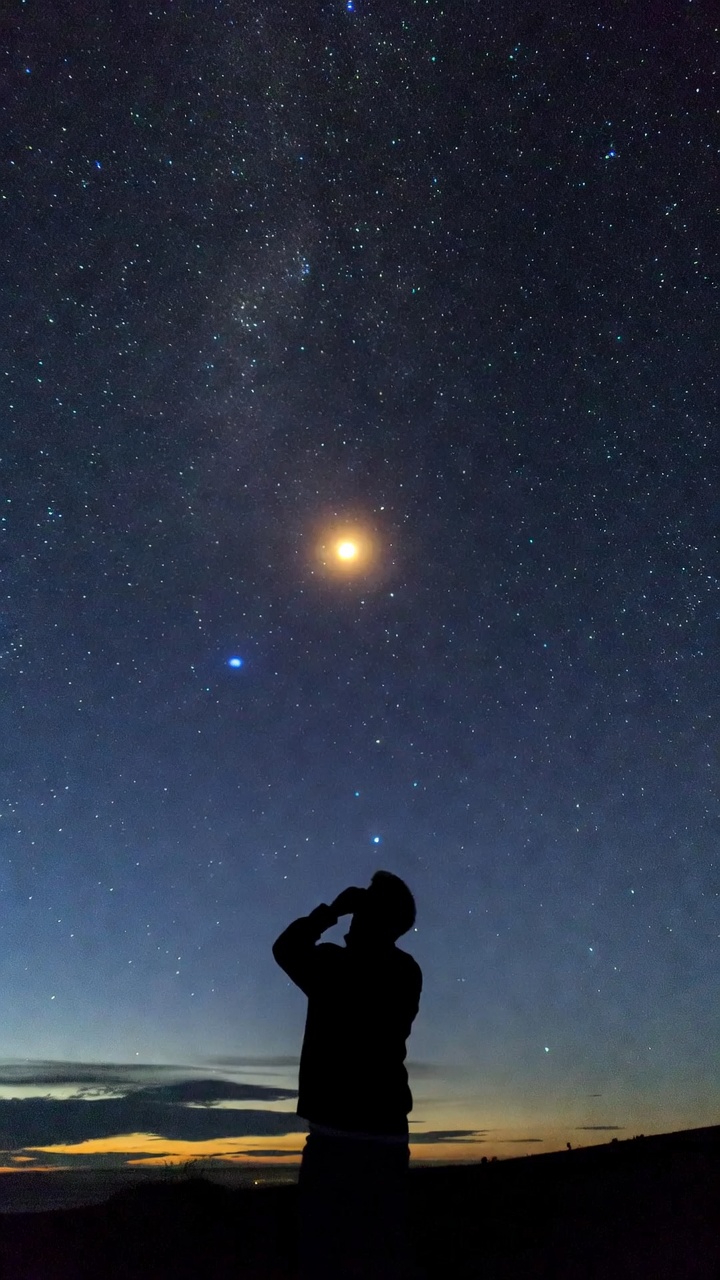
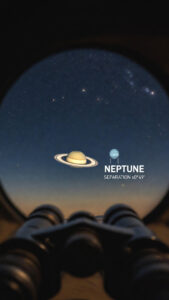
Tonight, Saturn and Neptune form a stunning close conjunction in the western sky after sunset; the tightest visual approach of their rare 2025–2026 triple series, with the planets separated by less than 1°, marking the finale of alignments not seen this close since 1989 and not repeating until around 2062
Saturn, shining brightly at magnitude around 1.0 as a steady golden point, dominates the view to the naked eye. Neptune, faint at magnitude 7.9, appears as a tiny bluish dot right beside it; so close both easily fit in a single binocular field. This marks the end of their multi-month dance in Pisces (transitioning toward Aries), where they shared right ascension three times: June 29, 2025 (~0°59′), August 6, 2025 (~1°09′), and now the closest visual minimum around February 20 (~0°49′ separation). The exact astrological conjunction peaks February 20 at 0°45′ Aries, but tonight delivers peak evening visibility before they sink into twilight. Look west-southwest 30–60 minutes after sunset for the best shot; Saturn guides you, then binoculars reveal Neptune nearby. This generational event reminds us of the solar system’s slow, graceful rhythms: outer planets take decades to realign, creating spectacles once-in-a-lifetime for many observers.
Fundamentals of Saturn-Neptune Conjunctions
Saturn (structure, boundaries, reality) and Neptune (dreams, dissolution, illusion) meet roughly every 36 years due to their orbital periods; Saturn’s ~29 years, Neptune’s ~165 years. Conjunctions blend these energies: Saturn grounds Neptune’s visions, or Neptune erodes Saturn’s rigidity, often correlating with societal shifts, ideological changes, or boundary redefinitions
The 2025–2026 series is a triple conjunction; three close passes from relative motion and retrogrades; culminating now. Closest approaches occur when right ascension aligns; visual separation minimizes around February 20 (~49 arcminutes, or Moon-width). Neptune’s faintness requires aid, but proximity makes it accessible.
Analogize to slow dancers: Saturn circles faster, “lapping” Neptune multiple times in this window, creating three “close passes” visible over months.
How to Observe Tonight’s Close Conjunction
Step outside 30–60 minutes after sunset; look west-southwest where the sky still holds twilight glow
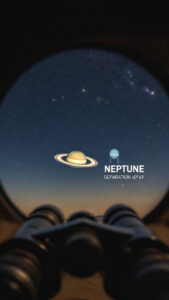
- Saturn: Easy naked-eye target; steady, non-twinkling golden “star.” Its rings (tilted modestly ~6°) show in small telescopes.
- Neptune: Scan ~0.5–1° from Saturn with binoculars (7×50 or 10×50 ideal); appears as faint blue-gray point. Small telescope resolves tiny disk.
- Best conditions: Clear, dark western horizon; away from lights. Low altitude means atmospheric haze dims Neptune; catch early.
- Apps (Stellarium, SkySafari) pinpoint exact spot/time for your location.
If clouds block tonight, the pair remains close for days; try February 20 peak minimum. No special gear beyond binoculars needed for the thrill.
Why This Event Feels Generational; and Its Cosmic Context
Saturn-Neptune conjunctions recur ~every 36 years (last major 1989 in Capricorn, triple with notable historical echoes). This series stands unique: tightest since 1989, with exact alignment at 0° Aries (zodiac “gateway”); a point amplifying visibility and new-cycle energy
The cycle launches themes unfolding to ~2061: blending discipline with imagination, confronting illusions with structure, or redefining boundaries (personal/societal). Visually, tonight’s closeness highlights orbital mechanics; slow outer worlds create prolonged, rare spectacles.
Amateur observations contribute to tracking; networks log such events for refinement.
Don’t Miss This Fleeting Beauty
Tonight’s alignment; Saturn and Neptune side by side in twilight; offers quiet magic: distant giants appearing intimate from our tiny vantage. In an era of fast change, these slow cosmic events ground us in deeper rhythms.
Grab binoculars, step out west after sunset, and scan near Saturn for Neptune. Spot them? Share the moment; perhaps with friends under the stars. If missed, decades pass before similar closeness returns.
Clear skies, steady views, and enjoy the generational dance. The solar system moves beautifully and deliberately; tonight, two giants remind us to pause and look up.


Leave a Reply