


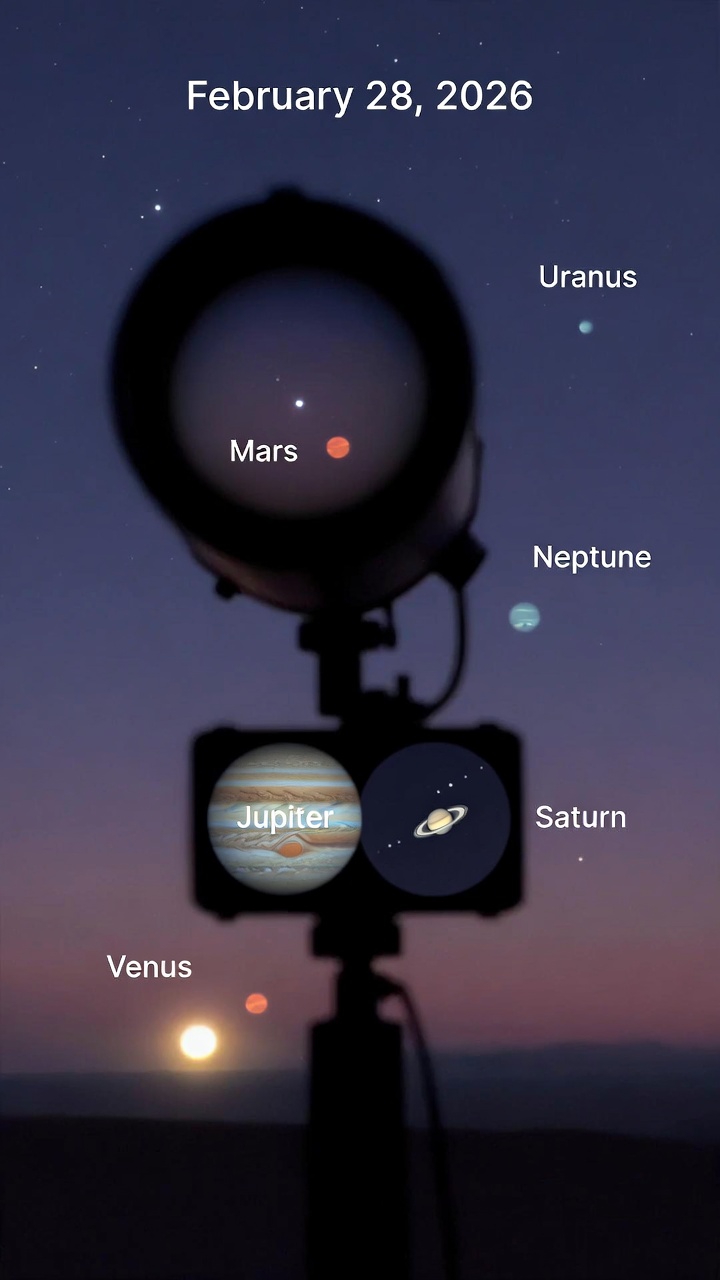
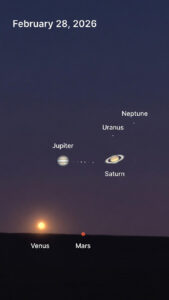
On the morning of February 28, 2026, the eastern sky before sunrise will host a rare and beautiful six-planet alignment; Venus, Mars, Jupiter, Saturn, Uranus, and Neptune; stretching across the horizon in a sweeping celestial lineup that invites stargazers, photographers, and casual observers to witness multiple worlds in a single breathtaking view.
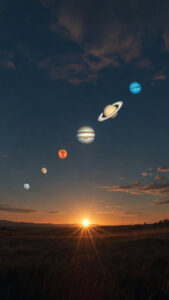
This pre-dawn spectacle unfolds as the planets appear clustered along the ecliptic, the apparent path of the Sun across the sky, due to their roughly coplanar orbits around the Sun. From our Earth-bound perspective, they form a wide arc rising in the east, with Venus blazing brightest as the unmistakable morning “star,” Mars adding its distinctive reddish hue, Jupiter and Saturn shining steadily higher up, and the faint ice giants Uranus and Neptune waiting to be found with binoculars or a small telescope. The alignment peaks around February 28 but remains impressive for several days around that date. With the Moon absent or very thin (waning crescent low in the east), the sky stays dark enough for fainter objects. Set your alarm early, find an unobstructed eastern horizon, and let the solar system put on its quiet, majestic show; one of the most accessible multi-planet gatherings of the year.
Understanding Planetary Alignments: Perspective and Orbital Dance
Planetary alignments, often called planet parades, are illusions of viewpoint: the planets do not physically line up in space but project along the ecliptic from Earth. All major planets orbit the Sun in nearly the same plane (within a few degrees), so they appear to follow roughly the same sky path.
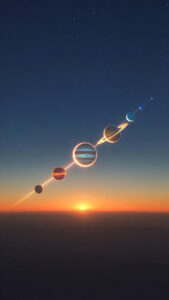
Morning alignments occur when planets rise before the Sun. In late February 2026, inner Venus and Mercury (though Mercury is not in this lineup) hug the horizon, while outer Jupiter, Saturn, Uranus, and Neptune climb higher earlier. Mars, positioned farther along its orbit, slots in between.
Such wide alignments happen periodically as faster inner planets overtake slower outer ones from our perspective. This particular six-planet morning display stands out for including both bright naked-eye worlds and the challenging ice giants.
How the February 28 Alignment Appears in the Sky
About 45–90 minutes before sunrise (exact timing depends on location), look east:
- Venus: Dominates low in the east-southeast at magnitude ~–4.4, impossible to miss; brightest object after the Moon.
- Mars: Glows distinctly reddish-orange (~magnitude 0.8–1.0), positioned somewhat higher and to the side of Venus.
- Jupiter: Brilliant white (~–2.2 magnitude), higher and easily visible; often the second-brightest point.
- Saturn: Steady golden-yellow (~0.7 magnitude), near Jupiter or slightly lower; contrast its color against twinkling stars.
- Uranus: Faint (~5.7 magnitude), near the Aries–Taurus border; binoculars reveal a greenish point; small telescope shows a tiny disk.
- Neptune: Dimmer (~7.8 magnitude), close to Aquarius–Pisces boundary; requires binoculars or telescope as a pale blue dot.
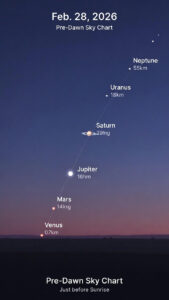
The planets span a wide arc (roughly 60–90°), not a tight line, making the view feel expansive. A clear, flat eastern horizon is essential; Venus and Mars set quickly after rising.
Viewing Tips for the Best Experience
To enjoy the full parade:
- Rise 60–90 minutes before sunrise; allow time for eyes to adapt to darkness.
- Choose an open eastern view: Avoid buildings, trees, or hills blocking the low horizon.
- Use binoculars: 7×50 or 10×50 help spot Uranus and Neptune; wide field captures multiple planets.
- Small telescope enhances: Jupiter’s moons and bands, Saturn’s rings (tilted modestly), Uranus/Neptune as disks.
- Dark site preferred: Minimize light pollution for fainter planets and richer star background.
- Check local sunrise time and planet positions with apps (Stellarium, SkySafari).
- Dress warmly; early mornings can be chilly; bring a chair or blanket for comfort.
If clouds intervene, try adjacent days; the alignment persists with slight shifts.
Why This Morning Alignment Captivates; and Its Place in 2026
This event highlights the solar system’s orderly yet dynamic motion: planets at different speeds create fleeting groupings visible to anyone with a clear horizon. It contrasts with evening parades earlier in the month, offering variety in a year rich with sky events (eclipses, conjunctions, meteor showers).
For photographers, the lineup against twilight gradients creates stunning wide-angle shots. For enthusiasts, finding the ice giants adds a rewarding challenge. For everyone, it fosters wonder; tiny Earth seeing distant worlds rise together.
Gather friends or family; share binoculars and stories under the stars. In a busy world, pausing for a planetary parade reconnects us to cosmic scale and beauty.
As February 28 approaches, set your alarm and face east. Whether you spot four bright points or all six, the experience delivers quiet awe. The solar system is parading at dawn; clear skies, steady eyes, and enjoy the rare celestial sweep.


Leave a Reply