



On February 18, 1930, Clyde Tombaugh spotted a faint, moving point of light at Lowell Observatory, forever changing our view of the solar system today marks 96 years since Pluto’s discovery, a tiny, enigmatic world that captured hearts as the ninth planet before its 2006 reclassification as a dwarf planet, yet remains one of the most beloved and surprising bodies in our cosmic neighborhood

Pluto’s story blends human curiosity, scientific debate, and breathtaking revelations. Discovered amid a search for “Planet X” to explain orbital wobbles (later attributed to measurement errors), the distant, dim object defied expectations from day one. Its eccentric, tilted orbit and small size sparked skepticism even then. For decades it reigned as the ninth planet in textbooks and imaginations—until the International Astronomical Union’s 2006 definition of “planet” required clearing its orbital path, demoting Pluto to dwarf planet status alongside Eris, Ceres, Haumea, and Makemake. Far from diminishing its allure, the debate only deepened fascination. NASA’s New Horizons flyby in 2015 unveiled a surprisingly complex, geologically active world with a giant heart-shaped glacier, towering ice mountains, and a hazy blue atmosphere proving Pluto is far more than a frozen relic. On this Discovery Day, we celebrate the little world that keeps surprising us, reminding everyone that exploration often reveals more questions than answers
The Historic Discovery: Clyde Tombaugh’s Patient Hunt
In the late 1920s, Percival Lowell’s observatory sought a hypothetical ninth planet perturbing Uranus and Neptune. After Lowell’s death, the search continued under Vesto Slipher and later Clyde Tombaugh, a 24-year-old self-taught astronomer from Kansas.

Tombaugh used a blink comparator—a device flipping between two photographic plates taken weeks apart—to detect motion against fixed stars. On February 18, 1930, comparing January 23 and 29 plates, he noticed a tiny dot shifting position. Confirmation plates followed, and on March 13, 1930 (Lowell’s birthday), Pluto was announced to the world.
Named by 11-year-old Venetia Burney (granddaughter of an Oxford astronomy professor), “Pluto” evoked the Roman god of the underworld fitting for a distant, dark object. Its discovery thrilled the public but puzzled astronomers: at magnitude 15, it was far dimmer than expected for Planet X.
Pluto’s Unusual Traits: Why It Always Stood Apart
Pluto’s orbit is wildly eccentric (e = 0.25), ranging from 30 to 49 AU, sometimes closer to the Sun than Neptune (as it was from 1979–1999). Its 17° inclination tilts sharply relative to the ecliptic plane, and its 248-year orbit is locked in a 3:2 resonance with Neptune.
Estimated diameter ~2,377 km (smaller than our Moon), mass just 0.002 Earth masses tiny compared to gas giants. Early estimates suggested it was massive enough to perturb outer planets; later measurements showed it was far lighter.
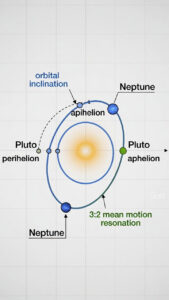
These quirks fueled debate: was Pluto a true planet or something else? The 2006 IAU definition required three criteria: orbit the Sun, be spherical, and clear its neighborhood. Pluto meets the first two but shares its zone with Kuiper Belt objects, earning dwarf planet status.
New Horizons Revelations: A World Far More Complex Than Expected
Launched in 2006, NASA’s New Horizons spacecraft flew past Pluto on July 14, 2015, capturing the first close-up images. The results stunned scientists:
- Tombaugh Regio, the iconic heart-shaped bright region, is a vast nitrogen-ice glacier spanning ~1,000 miles, slowly convecting and resurfacing itself.
- Hillary Montes and Tenzing Montes icy mountains up to 3.5 km tall—suggest recent geological activity.
- A hazy, layered atmosphere of nitrogen, methane, and carbon monoxide extends far, with blue tholins scattering sunlight.
- Diverse terrains: smooth plains, pitted uplands, cryovolcanoes, and possible subsurface ocean hints.
 These features indicate Pluto remains geologically active despite frigid temperatures (~-230°C), likely powered by residual heat and radioactive decay.


Leave a Reply