


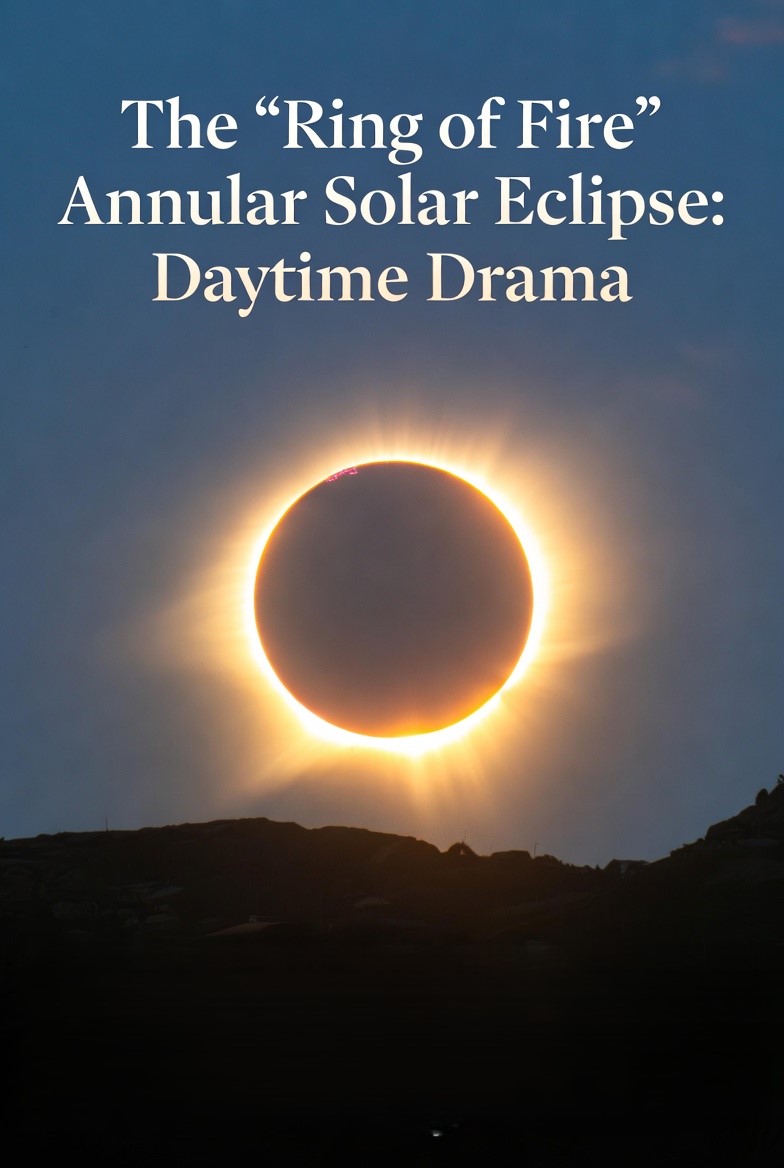
February 17, 2026, delivers an extraordinary astronomical double feature: a dramatic “Ring of Fire” annular solar eclipse during the day, followed by the closest approach of Comet C/2024 E1 (Wierzchos) after sunset a rare alignment of solar and cometary events that highlights the dynamic nature of our solar system.
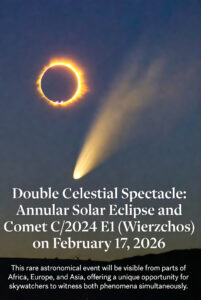
By day, the annular solar eclipse transforms the Sun into a blazing ring as the Moon, near its farthest point from Earth (apogee), partially covers the solar disk, leaving a brilliant annulus of sunlight. This path crosses remote western Antarctica with maximum annularity of 2 minutes 20 seconds near 64°S, 87°E, while partial phases extend to southern South America and southern Africa. As evening falls, Comet C/2024 E1 (Wierzchos) an ancient Oort Cloud wanderer reaches perigee (closest approach to Earth) at about 1.01 AU (~94 million miles or 151 million km), roughly the Earth-Sun distance. Fresh from perihelion on January 20, 2026, the comet glows at around magnitude 7–8, displaying a coma and possibly a faint tail from outgassing ices like carbon dioxide. Binoculars under dark skies reveal this fuzzy visitor drifting slowly among the stars in Sculptor or nearby constellations. One event demands daytime caution with filters; the other invites relaxed night viewing. Together, they make February 17 a standout date for astronomy enthusiasts worldwide daytime fire and evening ice in cosmic harmony.
The “Ring of Fire” Annular Solar Eclipse: Daytime Drama
An annular solar eclipse unfolds when the Moon’s apparent size is smaller than the Sun’s due to its position near apogee (February 10, 2026). The Moon covers about 96% of the Sun (eclipse magnitude 0.963), creating a glowing ring rather than total darkness.
The path of annularity—where the ring is visible stretches roughly 2,661 miles (4,282 km) long and up to 383 miles (616 km) wide, primarily over western Antarctica. Greatest eclipse occurs around 12:13 UTC, with annularity lasting up to 2 minutes 20 seconds. Partial phases affect broader areas: southern tips of South America (Chile, Argentina), southern Africa (South Africa, Mozambique, Madagascar), and vast ocean regions.
The eclipse begins with partial onset ~09:56 UTC, peaks midday, and ends later. In Antarctica’s summer, clear weather could yield stunning views from research stations like Concordia or Mirny. For most observers, live streams from NASA, observatories, or expeditions provide the best access.
Safety is critical: never look directly at the Sun without certified solar eclipse glasses (ISO 12312-2) or filters permanent eye damage can occur instantly
Comet C/2024 E1 (Wierzchos): Evening’s Icy Visitor at Perigee
Comet C/2024 E1 (Wierzchos), discovered in March 2024 by astronomer Kacper Wierzchos, is a long-period comet from the distant Oort Cloud on a hyperbolic orbit—likely ejected from the solar system after this pass.
It reached perihelion (closest to Sun) on January 20, 2026, at 0.566 AU (~85 million km), activating volatile ices and creating a glowing coma (dust/gas envelope) and faint tail. On February 17, it makes perigee at ~1.01 AU, appearing at magnitude ~7–8 (fading slightly post-perihelion). Best viewed in the Southern Hemisphere, where it’s higher and darker; Northern observers face challenges with low altitude or twilight interference.
Look south/southwest after sunset in dark skies use binoculars (7×50 or larger) to spot the fuzzy patch near Sculptor or Cetus. A small telescope may reveal coma structure or a short tail. Magnitude estimates suggest it’s binocular-visible under Bortle 4 or darker conditions; naked-eye possible in very dark sites if brighter than expected.
This is a one-time show the comet’s outbound path takes it far away forever.
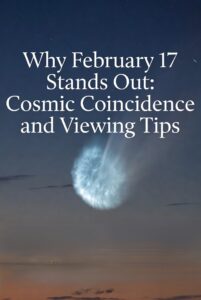
Why February 17 Stands Out: Cosmic Coincidence and Viewing Tips
These events coincide by orbital chance: the new moon (causing the eclipse) aligns with the comet’s perigee timing. The eclipse highlights Sun-Moon-Earth geometry; the comet showcases icy volatiles awakening near the Sun.
To maximize the day:
- Eclipse: Use certified filters for partial views (if in affected regions); watch streams for annular phase. Indirect pinhole projectors work safely.
- Comet: Head to dark sites post-sunset; allow eyes to adapt (20–30 minutes). Apps like Stellarium plot positions comet near RA 01h, Dec -31° around perigee.
- General: Clear skies essential; share with friends for added fun.
This double-header underscores astronomy’s accessibility one daytime spectacle for safety-conscious viewing, one nighttime for relaxed wonder.
As February 17 unfolds, embrace the rarity: a fiery solar ring by day, an ancient icy traveler by night. The universe aligns these wonders perfectly step outside, look up (safely), and savor the cosmic show. Whether chasing the ring or hunting the comet, February 17 promises memories that last a lifetime. Clear skies and stellar sights await!


Leave a Reply