


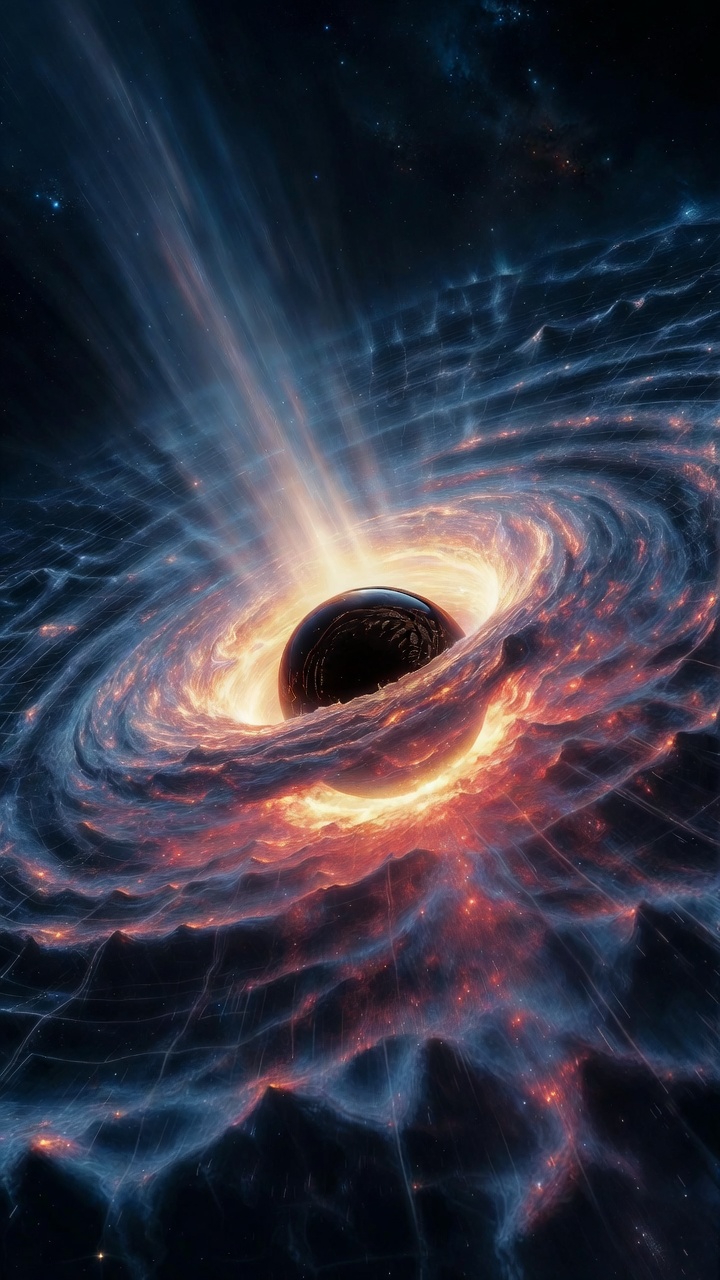
Recent artificial intelligence-driven analysis of Event Horizon Telescope data reveals that Sagittarius A, the supermassive black hole at the Milky Way’s heart, spins at 80–90% of its theoretical maximum approaching the extremal limit where spacetime itself twists dramatically while its rotational axis tilts toward Earth, offering an ideal vantage point amid chaotic magnetic turbulence.
This breakthrough, emerging from studies in mid-2025, harnesses neural networks trained on millions of synthetic simulations to pierce the noisy veil of observations from the galactic center. Sagittarius A* (Sgr A*), with a mass about 4 million times that of the Sun, powers the dense stellar core 27,000 light-years away. Its rapid spin drags spacetime via the frame-dragging effect predicted by general relativity, energizing the surrounding accretion disk and jets. The alignment of its spin axis nearly face-on from our perspective—sharpens the silhouette we see, while unexpected magnetic field turbulence suggests more dynamic plasma flows than models anticipated. These findings refine our grasp of black hole physics, galaxy formation, and extreme gravity, showing how AI unlocks hidden details in blurry data. As February 2026 unfolds, this work continues to reshape cosmology’s view of the universe’s most extreme engines.
Fundamentals of Black Hole Spin and the Kerr Metric
Black holes aren’t static voids; rotating ones follow the Kerr metric, describing spacetime around a spinning mass. Key parameter: the dimensionless spin a (or α), ranging from 0 (non-rotating Schwarzschild) to nearly 1 (extremal Kerr). At a ≈ 1, the event horizon shrinks, and an ergosphere forms where spacetime drags so fiercely that objects must co-rotate or escape.
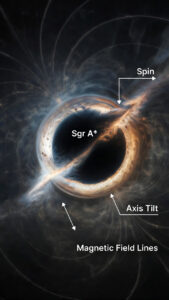
For supermassive black holes like Sgr A*, spin arises from mergers and accretion over billions of years. High spin extracts rotational energy via the Blandford-Znajek process, launching powerful jets that influence galactic evolution—regulating star formation by heating gas or expelling it.
The Event Horizon Telescope (EHT) images the shadow cast by the event horizon against glowing plasma. Sgr A*’s 2022 image appeared fuzzy due to rapid variability, interstellar scattering, and limited baselines. Traditional models struggled; enter AI.
Neural networks, like Bayesian ones in the ZINGULARITY framework, learn from GRMHD (general relativistic magnetohydrodynamic) simulations, mapping noisy data to parameters: spin, inclination, magnetic flux, electron temperature.
AI Breakthrough: Decoding Sgr A*’s Near-Extremal Spin
In 2025 research (published in Astronomy & Astrophysics), teams led by Michael Janssen (Radboud University) trained neural networks on over 12 million synthetic EHT observations from GRMHD models. These self-learning systems filter foreground effects like Faraday rotation and calibration biases.
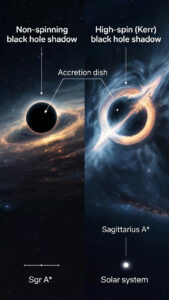
Applied to 2017 EHT data, the network infers Sgr A*’s spin at ~0.8–0.9 (80–90% of maximum), favoring prograde accretion (disk orbiting in spin direction). This high value approaches extremal limits, where further increase risks naked singularities (theoretical instabilities).
The rotational axis inclines ~20 40 degrees to our line of sight nearly face-on explaining the compact, variable shadow. Face-on views highlight Doppler beaming and frame-dragging asymmetries.
Turbulence emerges: magnetic fields show unexpected chaos near the horizon, deviating from standard MAD (magnetically arrested disk) or SANE models. Strong, spiraling fields (revealed in polarized 2024 images) interact wildly with infalling plasma, driving flares and outflows.
This refines earlier bounds, narrowing uncertainties dramatically.
Implications for Galaxy Evolution and Extreme Physics
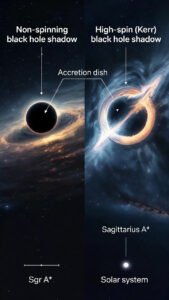
High spin stores vast energy extractable to power relativistic jets that clear gas, quenching starbursts and shaping spiral arms. Sgr A*’s near-extremal rotation suggests efficient growth history, perhaps via major mergers or prolonged aligned accretion.
The face-on alignment is fortunate: it maximizes observable asymmetries, testing relativity under extreme conditions. Frame-dragging twists light paths, creating lensed features visible in polarized light.
Chaotic fields hint at instabilities or non-standard accretion, challenging models and prompting revisions to how black holes regulate host galaxies.
Broader impacts: better spin constraints improve tests of general relativity vs. alternatives (e.g., modified gravity). Future EHT upgrades (e.g., Africa Millimeter Telescope) could triple precision, probing quantum gravity hints.
A New Window on the Galactic Core—and Cosmic Extremes
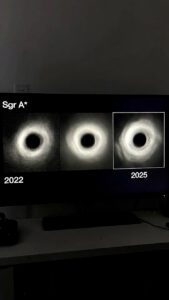
This AI-powered leap transforms noisy snapshots into precise portraits of Sgr A*’s dynamics. From 2022’s first fuzzy image to 2025’s spin revelations, progress accelerates.
The near-maximum rotation and Earthward axis offer a privileged lab for relativity’s frontiers. Turbulent fields underscore complexity black holes aren’t simple; their environs pulse with unpredictable energy.
As observatories expand, expect sharper views: higher-resolution movies of flares, jet launches, perhaps even horizon-scale quantum effects.
For now, these discoveries humble us: at our galaxy’s heart spins a beast warping reality itself, aligned as if to whisper secrets across 27,000 light-years. The universe’s most extreme objects keep surprising, driven by human ingenuity and cosmic fortune. Look toward Sagittarius on clear nights though invisible to eyes, its shadow dances in data, revealing a spinning giant that bends space, time, and our understanding forever.


Leave a Reply