


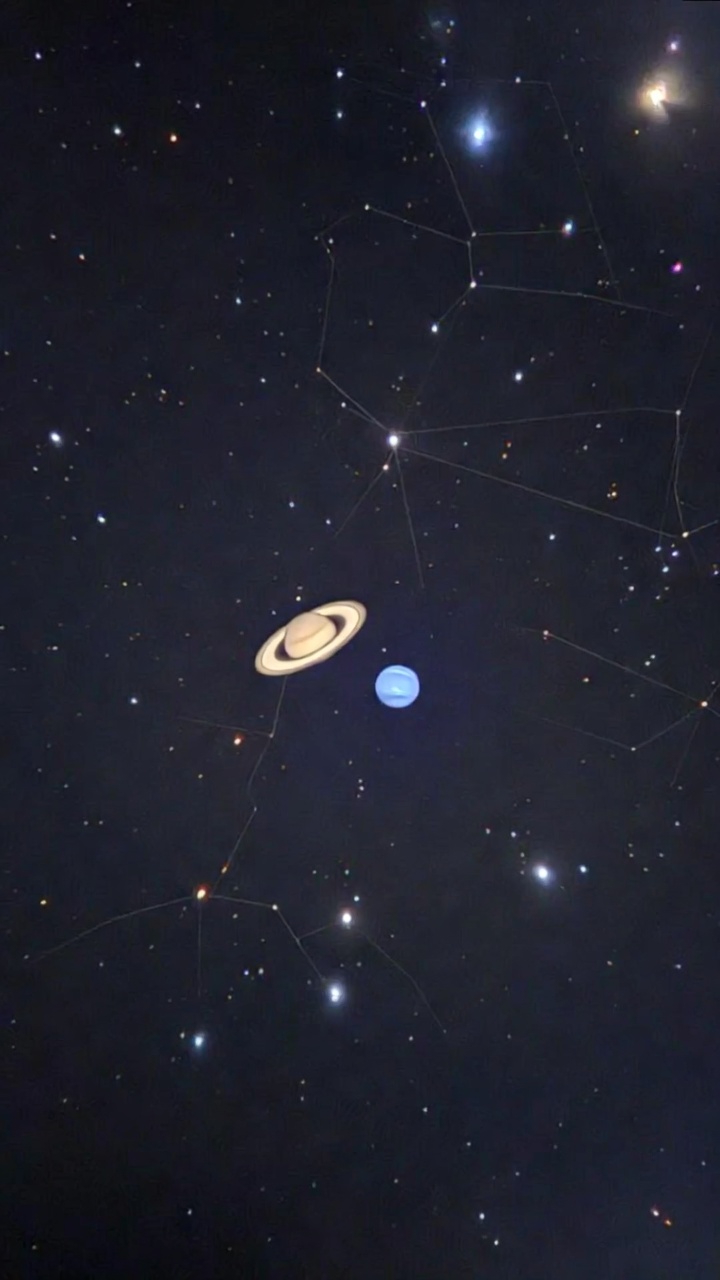
Tonight, February 16, 2026, skywatchers get a front-row seat to the dramatic finale of a rare Saturn-Neptune triple conjunction in Pisces the planets appear less than 1° apart, their close
st visual pairing in this cycle, offering a stunning binocular treat in the southwest after sunset before they won’t align this tightly again until 2132
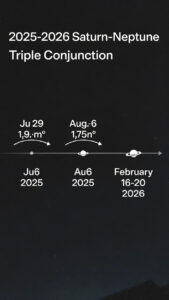
This marks the third and tightest meeting in a series that began in 2025: first on June 29 (separation ~0°59′), second August 6 (~1°09′), and now this February 16 event at ~0°54′ separation (exact right ascension alignment at 03:38 UTC / 03:38 GMT). The planets continue closing to a minimum ~0°49′ by February 20, but tonight delivers peak excitement for evening viewers. Saturn, shining brightly at magnitude ~1.0 as a steady golden “star,” guides the way; faint Neptune at magnitude 7.9 appears as a tiny bluish dot nearby requiring binoculars or a small telescope to spot. In the constellation Pisces, low in the southwest shortly after sunset, the pair hovers ~32° from the Sun, setting within a couple hours. This once-in-a-lifetime closeness (in this triple setup) highlights the outer planets’ slow orbital dance Saturn circles every 29 years, Neptune every 165 creating such alignments roughly every 36 years, but triple ones add extra rarity. Grab binoculars, find a clear western horizon, and join the cosmic watch party who’s heading out to spot them?
Fundamentals of Planetary Conjunctions and This Triple Series
A conjunction occurs when two planets share similar right ascension (celestial longitude), appearing close from Earth though vast distances separate them (Saturn ~10 AU, Neptune ~30 AU). Triple conjunctions happen when relative motions cause three close passes over months/years, due to Earth’s orbit and the planets’ paths.
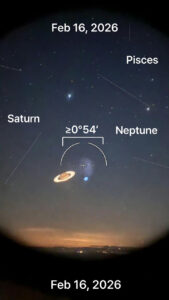
For Saturn-Neptune, cycles repeat ~every 36 years (last major one 1989 in Capricorn). This 2025–2026 triple unfolds in Pisces (ending there), with the final stage in early 2026 as Saturn overtakes Neptune before both shift to Aries later. The February 16 alignment (separation 54 arcminutes) is the exact right ascension match; visual minimum hits February 20 (~49 arcminutes, under 1°). Binoculars easily fit both in one field—Saturn’s disk shows faintly in small scopes, Neptune as a star-like point.
Analogize to cars on a track: faster Saturn “laps” slower Neptune multiple times in this window, creating three “overtakes” visible as close approaches.
How to Observe Tonight’s Close Approach
Step outside 30–60 minutes after sunset—look southwest, where Saturn stands out as the brightest “star” in that direction (steady light, no twinkling). Pisces lies between Aquarius and Aries; use Saturn as your beacon.
With 7×50 or 10×50 binoculars, scan around Saturn Neptune should pop as a faint blue-gray speck within 0.5–1° (roughly the Moon’s width). In a small telescope (60–100mm aperture),
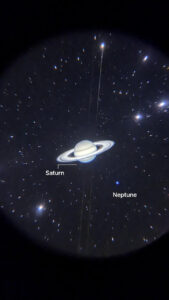
Saturn shows its rings (tilted modestly), while Neptune appears as a tiny disk. Higher power helps resolve Neptune’s color.
Best conditions: Clear, dark skies away from city lights; low horizon unobstructed (trees, buildings). Twilight fades quickly catch it early before they set. The Moon (waxing gibbous) rises later, so early evening favors darker backgrounds.
Apps like Stellarium or SkySafari pinpoint exact positions/times for your location. If clouds interfere, online telescope streams from observatories may capture it.
Why This Triple Conjunction Stands Out—and Its Cosmic Context
This event caps a multi-year approach: Saturn and Neptune were within a few degrees through late 2025 into 2026. The triple nature—three distinct close passes—makes it rarer than single conjunctions. Next Saturn-Neptune meet ~2061, but no triple until much later (2132 mentioned in some contexts for similar closeness).
Astronomically, it showcases outer planet dynamics slow movers create prolonged spectacles. No dramatic effects like shadows or occultations, but the visual proximity thrills amateurs tracking planetary motions.
tracking planetary motions.
Astrologically (though observational focus here), such alignments often symbolize blending structure (Saturn) with dreams/dissolution (Neptune), especially as they transition to Aries soon after.
Scientifically, observing them together aids calibration, though main value is personal wonder—seeing distant worlds aligned from backyard vantage.
Embrace the Moment: Step Out and Share the View
Tonight’s show reminds us the solar system performs subtle, long-term ballets visible to patient eyes. With Saturn guiding and Neptune whispering nearby, it’s a quiet thrill proof distant giants can appear intimate.
Who’s venturing out? Grab binoculars, bundle up, and scan southwest. Spot them? Share your view whether a quick phone snap through binocs or just the satisfaction of seeing it. In a fast world, pausing for planets reconnects us to cosmic scale.

These alignments won’t repeat soon next chance decades away. Clear skies, steady hands, and enjoy the rare dance of Saturn and Neptune. The universe is aligning tonight don’t miss your chance to witness it.


Leave a Reply