


As February 2026 draws to a close, the skies above offer two unforgettable eclipses just weeks apart—the dramatic “Ring of Fire” annular solar eclipse on February 17 and a vivid total lunar eclipse on March 3. These events highlight the precise choreography of our solar system and provide accessible wonders for sky watchers worldwide
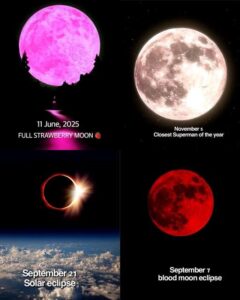
Imagine the Sun briefly transforming into a blazing ring of golden light, or the full Moon glowing an eerie reddish hue as Earth’s shadow engulfs it. These aren’t everyday sights; eclipses like these occur only when the Sun, Moon, and Earth align almost perfectly. The February 17 annular solar eclipse, dubbed the “Ring of Fire,” happens because the Moon is near its farthest point from Earth (apogee), appearing slightly smaller and unable to fully cover the Sun. Instead, it creates a stunning annulus of sunlight around the Moon’s dark disk. Just two weeks later, on March 3, a total lunar eclipse turns the Moon into a “blood moon,” bathed in refracted sunlight passing through Earth’s atmosphere.
Imagine the Sun briefly transforming into a blazing ring of golden light, or the full Moon glowing an eerie reddish hue as Earth’s shadow engulfs it. These aren’t everyday sights; eclipses like these occur only when the Sun, Moon, and Earth align almost perfectly. The February 17 annular solar eclipse, dubbed the “Ring of Fire,” happens because the Moon is near its farthest point from Earth (apogee), appearing slightly smaller and unable to fully cover the Sun. Instead, it creates a stunning annulus of sunlight around the Moon’s dark disk. Just two weeks later, on March 3, a total lunar eclipse turns the Moon into a “blood moon,” bathed in refracted sunlight passing through Earth’s atmosphere.
The Fundamentals of Solar and Lunar Eclipses
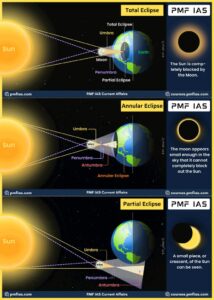
Solar eclipses unfold at new moon, when the Moon positions itself between Earth and the Sun, casting a shadow onto our planet. The shadow has two parts: the dark central umbra (for total eclipses) and the lighter surrounding penumbra (for partial views). In an annular case, the Moon’s apparent size is too small for a total block, so the umbra becomes an antumbra—a region where observers see the ring effect.
Lunar eclipses, by contrast, occur at full moon. Earth lies between the Sun and Moon, casting its shadow across the lunar surface. The umbra is Earth’s darkest shadow cone, where the Moon can enter fully for totality; the penumbra is fainter and causes gradual dimming. Sunlight bends through Earth’s atmosphere, scattering shorter blue wavelengths and leaving reds and oranges—hence the coppery “blood moon” color during totality.
These alignments are rare because the Moon’s orbit tilts about 5 degrees relative to Earth’s, so perfect lineups happen only a few times per year. Predictions rely on orbital mechanics, refined by organizations like NASA and timeanddate.com, ensuring we know exact paths and timings years in advance.
Mechanics of the February 17 “Ring of Fire” Annular Solar Eclipse
On February 17, 2026, the Moon covers about 96% of the Sun at maximum, leaving a brilliant ring visible along a narrow path of annularity. This path, roughly 2,661 miles (4,282 km) long and up to 383 miles (616 km) wide, crosses primarily Antarctica, with greatest eclipse at approximately 12:13 UTC near 64°S, 87°E. Annularity lasts up to 2 minutes and 20 seconds in the central zone.
The annular phase is visible only over remote parts of Antarctica, including areas near research stations like Concordia (French-Italian) and Mirny (Russian). Partial phases extend to southern tips of South America (e.g., southern Chile and Argentina), southern Africa (including South Africa, Mozambique, Madagascar), and vast ocean regions in the Pacific, Atlantic, and Indian Oceans. For most of the world—including Europe, North America, and Asia—the event remains invisible.
Picture this: as the Moon advances, daylight dims subtly, temperatures may dip slightly, and wildlife behaves unusually. At peak annularity, the Sun resembles a fiery donut, with beads of sunlight (Baily’s beads) sparkling along the Moon’s rugged edge due to lunar mountains. The corona remains faint compared to total eclipses, but the ring dominates—a surreal, almost alien view.
The Total Lunar Eclipse on March 3: A “Blood Moon” Spectacle
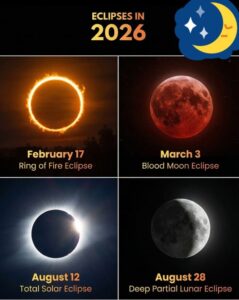
The March 3, 2026, total lunar eclipse offers broader accessibility. It begins with penumbral shading at 08:44 UTC, partial eclipse at 09:50 UTC, totality from 11:04 to 12:02 UTC (lasting 58 minutes), maximum at 11:34 UTC, and ends fully by 14:22 UTC spanning over 5 hours and 39 minutes’ total.
Visibility covers the night side of Earth: best from Australia, the Pacific, East Asia, and much of North and South America. In North America, western regions see prime early-morning views (e.g., totality around 4:04–5:02 a.m. MST), while eastern areas may catch only partial phases before moonset. Parts of Europe and Africa see rising or setting Moon views, though less complete.
During totality, the Moon turns deep reddish-orange as Earth’s atmosphere filters sunlight reds dominate because blue light scatters away, much like sunset colors. The brightness varies with atmospheric conditions; this eclipse is relatively shallow (umbral magnitude 1.15), so the Moon stays fairly bright and coppery rather than very dark.
No equipment required just an open view of the sky. It’s ideal for families, photographers, or anyone wanting a relaxed stargazing night.
Broader Implications, Safety, and Scientific Value

These eclipses underscore cosmic predictability while revealing subtle atmospheric and orbital details. Lunar eclipses help scientists study Earth’s upper atmosphere via color changes, and solar ones (even annular) allow glimpses of the Sun’s chromosphere. In 2026’s eclipse lineup—including a total solar eclipse in August—these early events set the stage for a year of skywatching.
For February 17: Safety first—never view the Sun directly without certified solar eclipse glasses or filters. Use indirect methods like pinhole projectors if needed. The intense focused light can cause permanent eye damage instantly.
For March 3: Enjoy freely with naked eyes, binoculars, or telescopes—no risk involved.
As these nights approach, step outside, look up, and marvel. In a fast-paced world, pausing for celestial events grounds us in wonder. Future missions like Artemis or advanced telescopes may unlock more eclipse secrets, but for now, the sky delivers free, timeless spectacles—reminders that some of the greatest shows require only clear eyes and an open heart.


Leave a Reply