


Inside a Black Hole: Where Gravity Warps Space, Time, and Reality Itself
Black Holes Explained: The Extreme Gravity That Bends Space and Freezes Time
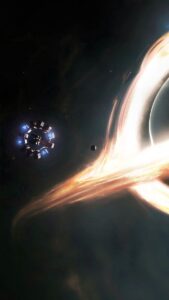
Black holes are among the most extreme objects in the universe, with gravity so powerful that it reshapes the very fabric of space and time. This immense pull is created when an enormous amount of mass is compressed into an incredibly small region, producing a gravitational field unlike anything else known to science.
At the edge of a black hole lies the event horizon an invisible boundary where gravity becomes unstoppable. Once anything crosses this point, whether light, matter, or energy, escape is impossible. Even light, the fastest traveler in the universe, is trapped because space itself curves inward so dramatically that every possible path leads deeper into the black hole.
Surprisingly, the region outside the event horizon can appear quite ordinary. Stars can orbit black holes, and entire galaxies can grow around them. As gas and dust spiral inward, they form a superheated accretion disk that glows intensely, emitting powerful X-rays and other high-energy radiation. This brilliant glow is often how scientists detect black holes, not by their darkness, but by the light created around them.
As predicted by Einstein’s theory of general relativity, gravity near a black hole causes time to slow down. To a distant observer, an object falling toward the event horizon appears to move increasingly slowly, becoming dimmer and redder, seemingly frozen just before crossing the edge.
If a human were to fall toward a black hole, the difference in gravitational pull between their feet and head would stretch their body into long strands—a dramatic effect known as spaghettification, highlighting the extreme and uneven nature of black hole gravity.
At the very center lies the singularity, a point where matter is crushed to infinite density and the known laws of physics cease to work. What truly happens there remains unknown, making black holes one of the greatest mysteries in modern science.
In essence, black holes are not cosmic vacuum cleaners, but powerful natural laboratories where gravity, space, and time behave in the most extraordinary ways—offering us a glimpse into the strange and fascinating nature of our universe.
Up to 10 Billion Earth-Like Planets May Exist in the Milky Way
The Milky Way may be far more crowded with Earth-like worlds than we ever imagined. According to scientific research, up to 10 billion planets similar in size to Earth could exist within our galaxy alone many of them potentially capable of supporting life.
In 2019, astronomers combined data from NASA’s Kepler Space Telescope with precise stellar measurements from the European Space Agency’s Gaia mission. Their analysis revealed a remarkable insight: roughly one out of every six stars may host an Earth-sized planet located within its habitable zone—the region around a star where conditions could allow liquid water to exist on a planet’s surface.
This discovery suggests that tens of billions of potentially Earth-like worlds may be scattered across the Milky Way, orbiting stars of various types and ages. As planet-hunting technology improves, scientists are also rethinking what it truly means for a planet to be “habitable.” Life may not require a perfect replica of Earth to emerge or evolve complexity, opening the door to a much wider range of environments where life could thrive.
With every new discovery, the possibility grows that Earth is not unique—and that the universe may be filled with far more life-friendly worlds than we once believed. 🌍✨
A Cosmic Stranger: Interstellar Object Passes Through Our Solar System

Astronomers have recently confirmed the discovery of a rare interstellar object passing through our solar system a cosmic visitor that did not originate from our Sun but traveled across vast distances from another star system. These extraordinary discoveries give us a unique glimpse into the material formed around distant stars, offering clues about planetary systems far beyond our own.
Unlike typical asteroids or comets, interstellar objects move at unusual speeds and follow paths that don’t align with the orderly orbits of solar system bodies. Their trajectories show they are not gravitationally bound to the Sun, making them true cosmic wanderers. Many of these objects were likely ejected from their home systems during the chaotic early stages of planet formation, when young stars fling debris across space.
The first known interstellar visitor was ʻOumuamua, discovered in 2017. Its unusual shape and lack of a comet-like tail sparked global fascination and scientific debate. Just two years later, 2I/Borisov arrived, displaying familiar cometary behavior releasing gas and dust as it warmed yet clearly originating from beyond our solar system.
These interstellar travelers are scientifically invaluable. They are essentially untouched samples of other planetary systems, carrying chemical signatures that reveal how planets and small bodies form elsewhere in the galaxy. By studying their composition, brightness, and motion, scientists can compare distant star systems to our own, helping answer questions about how common or unique our solar system really is.
Even more exciting is the possibility that many more interstellar objects pass through unnoticed. With advanced sky surveys and powerful telescopes coming online, astronomers expect to detect these visitors more frequently in the future. Each new discovery adds another piece to the puzzle of how star systems evolve and exchange material across the Milky Way.
In a poetic sense, interstellar objects are messengers from another sun silent, ancient, and fleeting. Their brief journeys through our cosmic neighborhood remind us that our solar system is not isolated, but part of a vast, dynamic galaxy where worlds form, collide, and sometimes send fragments drifting across the stars.


Leave a Reply